Point cloud modeling is the process of converting a raw 3D point cloud into a usable 3D model, 2D plan, or BIM deliverable, so a project team can build from a measured record of a structure instead of assumed dimensions. That 3D point cloud model is captured on site by a laser scanner or photogrammetry rig as millions of precisely measured 3D points, which hold only coordinates until a modeler traces and classifies them into walls, floors, and equipment a design program can read. Done right, that conversion produces an accurate as-built model a team documents, renovates, and verifies a structure from; done wrong, small errors in the geometry quietly seed clashes and rework downstream.
Producing one runs in three stages, capture, registration, and conversion, and only conversion turns the aligned scan into usable geometry, which works only when the cloud is dense, complete, and clean enough to trace. How accurate the finished model needs to be is then set by its purpose and graded on the LOD scale, not maximized blindly.
Beyond the build, the same models carry into as-built documentation, construction verification, and facility management, they run on a stack of registration and BIM authoring software, and they are often converted by an outside partner once the dataset turns large or the target LOD climbs.

What Is a Point Cloud Model?
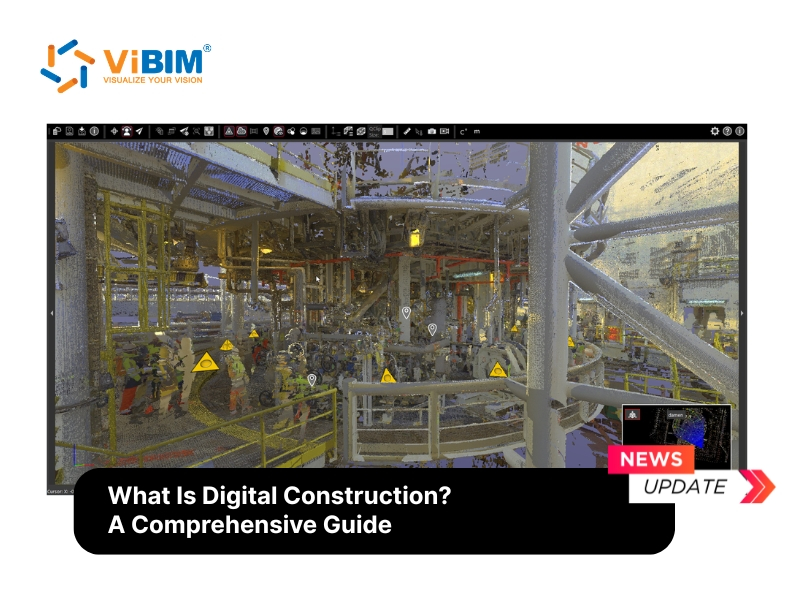
A point cloud model is a massive dataset of 3D coordinates, each point holding an X, Y, and Z position and often colour and intensity values, that together record the exact surface of a real object or space. Captured by LiDAR or photogrammetry, it acts as a precise digital record of as-built reality. On its own, though, it stays raw data: software reads coordinates, not walls or pipes, which is why the cloud has to be converted before a project team can build from it.
The sections below settle whether a 3D point cloud model is anything different, what the cloud actually carries, and how it differs from the model it becomes.

What Is a 3D Point Cloud Model?
A 3D point cloud model is the same measured dataset as a point cloud model, named after the three-axis coordinate space its points sit in. Every point is fixed on X, Y, and Z rather than plotted on a flat plane, which is what a photograph or a 2D survey drawing cannot give a project team. From that one dataset a team can cut a section at any level, measure between two points anywhere in the volume, and check a dimension from any angle without going back to site. A point cloud 3D model is not a denser or more advanced file either, only the same words in a different order.
What Data Does a Point Cloud Hold?
A point cloud holds several data values at every point, and each value shapes a decision the modeler makes when converting it. A single scan can hold hundreds of millions of points, and every one carries the same stack of values. The table below reads each value for what it records and the conversion decision it drives:
| Attribute | What it records | Why it matters when converting |
|---|---|---|
| XYZ coordinates | The point’s exact position in space | The geometric skeleton every wall and pipe is traced against |
| RGB color | A photographic color value | Lets the modeler read the scene and tell one surface from another |
| Intensity | The strength of the laser return | Distinguishes materials, a metal duct from matte plaster, even where color is unclear |
| Surface normal | The direction the surface faces | Helps detect flat planes and clean edges for accurate placement |
| Timestamp | When the point was recorded | Tracks how a space changes and aligns points from separate scan sessions |
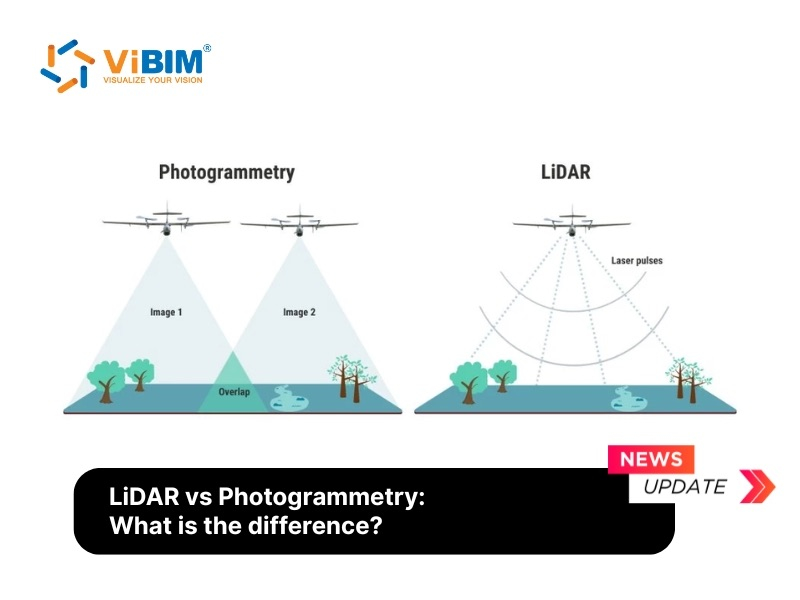
These points are produced by 3D laser scanning (LiDAR) or photogrammetry, where the scanner records the distance to every surface it sees. The result is rich in data but has no structure, and that gap between raw points and a usable model is where a point cloud and a 3D model part ways.

What Is the Difference Between a Point Cloud and a 3D Model?
The difference between a point cloud and a 3D model is structure: a point cloud is a raw mass of disconnected measured points, while a 3D model is organized geometry, a continuous mesh or intelligent parametric objects, that software and a team can read, dimension, and build from. The two sit at opposite ends of the conversion:
| 3D point cloud | 3D model | |
|---|---|---|
| What it is | A raw mass of disconnected measured points | Organized geometry a program can read |
| What it holds | Only coordinates, no named elements | Walls, floors, and equipment as defined objects |
| What you can do with it | View and measure points by hand | Select, schedule, clash-check, and edit elements |
This is why a project cannot use the raw cloud as its as-built model: nothing in it can be selected, scheduled, or clash-checked. Converting the cloud produces one of two forms:
- Mesh: a continuous skin wrapped over the points, best for visualization, organic or heritage shapes, and VR.
- Parametric model: intelligent objects that carry data, needed for engineering, coordination, and quantity analysis.
A BIM model is the intelligent, parametric form of that 3D model, the same measured geometry carried as scheduling-ready objects rather than a raw point cloud, which is the difference between a point cloud and BIM; turning one into the other is the scan-to-BIM step.
Which form fits your project is a decision in itself, weighed in our comparison of a point cloud model vs a mesh model. Whichever form the deliverable takes, producing it follows the same conversion path.

How Is a Point Cloud Model Created?
A point cloud model is created in three stages, capture, registration, and conversion, and only the last turns the aligned cloud into a usable 2D plan, 3D model, or BIM deliverable. The first two produce a clean, complete point cloud; the third converts that data into geometry a project team can build from.
1. Capture. Laser scanning is the usual first step in point cloud modeling: a laser scanner (LiDAR) or a photogrammetry rig records a site by measuring the distance to every surface it sees, storing each reading as a 3D point. Together those readings form the raw point cloud, the source data every later stage depends on.
How a site is scanned, and with what equipment, is covered in our guide to 3D laser scanning.
2. Registration. A single scan position rarely covers a whole site, so the separate scans are aligned into one point cloud in a shared coordinate system and cleaned of noise and stray returns. Accurate registration holds every later measurement true, while misalignment carries error into everything built on top.
How that alignment is performed is covered in our guide to point cloud registration.
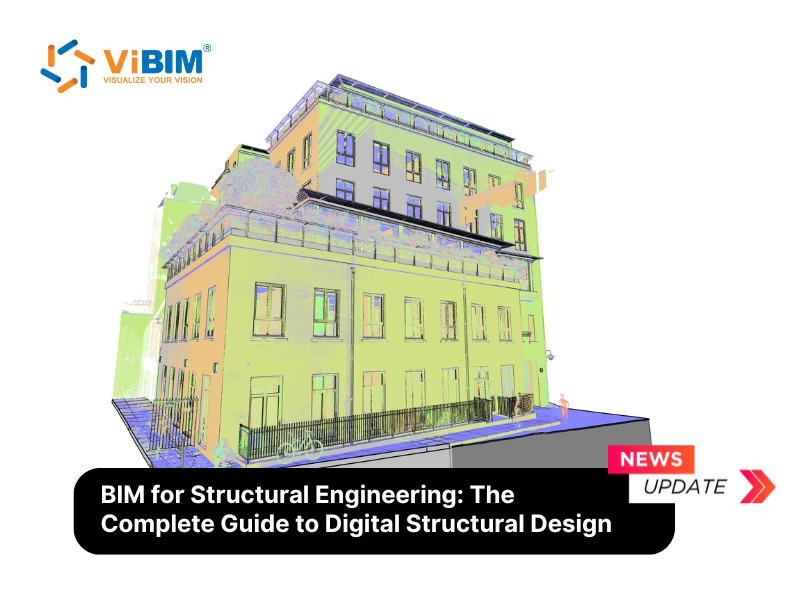
3. Conversion. With a clean, aligned cloud in place, a modeler converts it into whatever the project needs, a 2D plan, a 3D mesh or surface model, or an intelligent parametric BIM model. The point cloud data is imported into authoring software, its points are traced and classified into defined geometry, and a two-layer QA check then compares the finished model against the source cloud so the geometry matches reality. This conversion stage is the work we perform for clients who supply their own registered point cloud.
The end result is an accurate as-built model of the space, dimensionally true to the scan and ready to measure, coordinate, and build from. The form that model takes depends on the output required:
- For a mesh or general 3D conversion, see how to convert a point cloud into a 3D model.
- For a parametric BIM model, see point cloud to BIM.

Before a cloud can reach the conversion stage, it has to be complete enough to convert from.
What Makes a Point Cloud Good Enough to Convert?
A point cloud converts cleanly when four conditions hold, point density, coverage, registration accuracy, and low noise, because together they decide whether a modeler can trace a real surface or has to infer one. Each condition caps what the finished model can reach:
- Point density: how tightly the points are spaced. It must resolve the smallest element the model requires, a conduit run or a bolt pattern; too sparse, and small objects blur into nothing.
- Coverage: whether every surface was captured from enough angles. Blind spots behind equipment or in tight corners force assumed geometry in place of measured geometry.
- Registration accuracy: how cleanly the separate scans align. Misalignment ghosts or doubles walls and quietly corrupts downstream measurements.
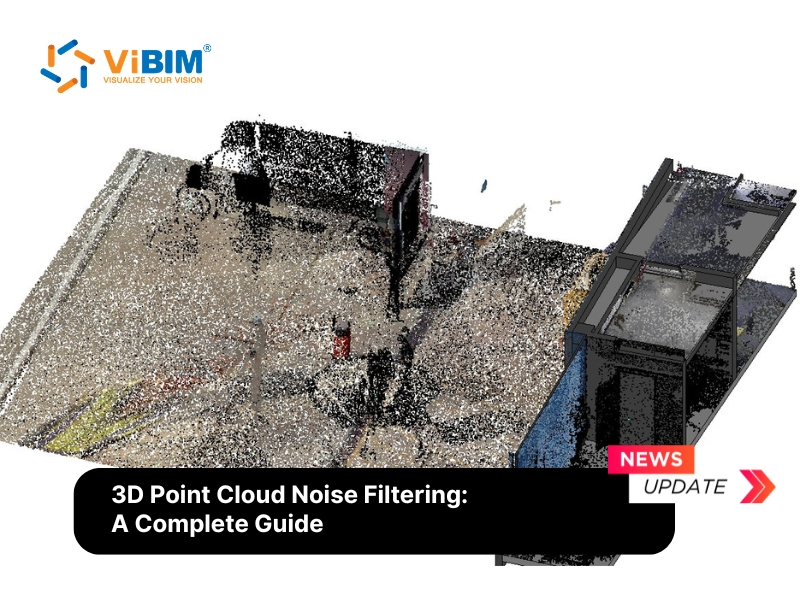
- Noise: stray points thrown by reflective glass, moving objects, or dust, cleared by point cloud noise filtering so the true surface stays readable beneath them.
File size is a separate question from quality. A very large, dense scan is no harder to convert; it simply has to be moved and staged carefully so none of the detail is stripped out, a challenge covered in handling massive point cloud datasets. A scan that looks messy is also not automatically a lost cause: a skilled modeler can often recover an accurate model by cross-referencing the cloud against site photographs, which is what turns a difficult scan into a usable one.

Once a scan clears these conditions, the point cloud becomes the foundation for a wide range of work across the built environment, whether a team uses it directly or converts it into a finished deliverable.
Cleaning the cloud is only half the preparation: point cloud segmentation splits the raw points into walls, floors and equipment, so a modeller knows what each cluster represents before tracing starts.
What Are Point Cloud Models Used For in the Built Environment?
Point cloud models are used across the built environment as the accurate, measured basis for work on structures that already exist. A team either works with the cloud directly, to measure, inspect, and verify against reality, or converts it into a 2D drawing or 3D/BIM model that the rest of the project builds on.
Across the built environment, the most common applications of point cloud data are:
- Scan to BIM: the point cloud is turned into an intelligent BIM model that design and coordination build on, and it is the most common of these uses.
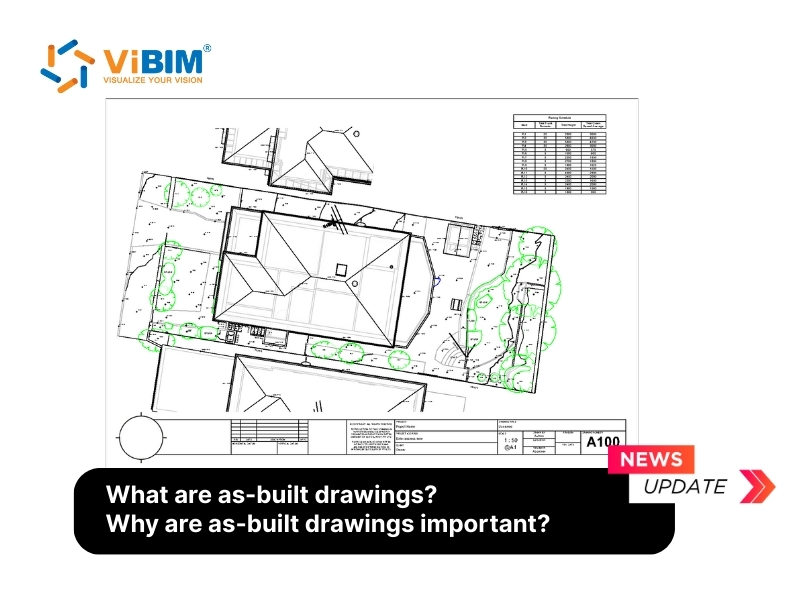
- As-built documentation: the cloud is the exact measured record of a structure as it stands, and the source from which as-built drawings and models are produced when the original drawings are missing or no longer match reality.
- Renovation and retrofit design: designers work against the cloud, or a model converted from it, so new work fits the fabric that is actually there instead of assumed dimensions.
- Construction verification (scan-vs-BIM): a scan of the built work is compared against the design model, a scan-vs-BIM check that flags deviation early while it is still inexpensive to correct, and the same overlay feeds progress monitoring and payment applications.
- Facility and asset management: a model converted from the cloud gives operators an accurate base for space planning, maintenance, and quantities, and the cloud itself anchors the digital twin of the asset.
- Heritage and digital preservation: the cloud captures intricate or fragile structures as a precise record for study, restoration, or archival, often converted to a mesh for visualization.
- Earthworks, civil, and infrastructure: site scans and terrain surveys feed earthworks and site grading, road alignments, and underground utility models, where measured ground beats assumed levels.
- Structural, MEP, and industrial plant: the cloud is traced into structural steel and concrete, MEP rough-in for coordination, and dense plant assets like pipelines and instrumentation that no drawing set fully captures.
How far any of these applications can rely on the point cloud comes down to a single question: how accurately it was captured.
How Accurate Is a Point Cloud Model?
A point cloud captures a site to millimeter accuracy, and the finished model holds that accuracy by tracing and QA-checking every element against the source cloud, within the tolerance each project sets, as tight as ±0.25 inch on fabrication work. Two things govern the outcome: how cleanly the site was scanned and registered, which is fixed once the scan is done, and how much of that precision the deliverable is built to carry, which is a choice.
That choice is set by the Level of Development (LOD), the standard grade for how much detail and reliability a model holds, so accuracy is matched to purpose rather than maximized blindly:
| LOD | What the model carries | Typical use |
|---|---|---|
| LOD 200 | Approximate geometry, generic elements | Early coordination and massing |
| LOD 300 | Accurate geometry and precise dimensions | As-built documentation and design |
| LOD 400 | Fabrication-level detail and embedded data | Fabrication and clash-free MEP |
What LOD 200, 300, and 400 mean in full is defined in our guide to the BIM Level of Development. Reaching a given grade reliably, on real projects, is where software, experience, and process come together.
What Software Is Used for 3D Point Cloud Modeling?
3D point cloud modeling runs on two categories of software: registration tools that clean and align the raw scan, and BIM or CAD authoring tools that build the editable model from it. No single program does the whole job, so the work moves across a small stack of tools. None of them classify geometry on their own, which is why a point cloud foundation model trained across many scan datasets is the research direction worth watching.
Registration tools clean and align the raw scan:
- Autodesk ReCap pre-processes and indexes the scan into RCP or RCS files.
- Leica Cyclone registers overlapping scan setups into one coordinate-true cloud.
BIM and CAD authoring tools build the editable model:
- Revit and ArchiCAD handle architectural and multi-discipline BIM; for Revit specifically, point cloud to Revit modeling covers the import, tracing, and validation workflow.
- Tekla Structures models detailed steel and concrete.
- Undet and similar plugins pipe the cloud directly into Revit or SketchUp to trace objects against.
Which of these a project needs is set by the deliverable, not the budget: the target LOD, whether the output is IFC or DWG, and how much data the model must carry decide the stack. For a side-by-side comparison, see our guide to the best scan to BIM software. Beyond the tools, what a point cloud model ultimately delivers to an AEC team is a set of concrete gains.
Key Benefits of Point Cloud Modeling for AEC Teams
The main benefit of point cloud modeling for an AEC team is a verified, editable as-built model that supports design, coordination, and construction against measured reality rather than assumptions. Four gains carry the most weight, and each appears on real projects:
- Accuracy you can verify: every element is checked against the source cloud, so the model reflects the field as measured rather than assumed.
- Clashes caught in the model, not on site: because coordination runs on an accurate as-built, conflicts surface before fabrication rather than during it.
- Modeling time reduced without losing detail: repetitive conversion is automated rather than hand-drawn, with custom Dynamo scripts, a visual-scripting tool inside Revit, saving up to 90% of the manual modeling time on large datasets.
- An editable, data-rich deliverable, on schedule: the client receives a native parametric model whose elements carry the category and attribute data a team mines for quantities and facility management, not a static mesh or flat PDF, backed by a 99% on-time record.
These gains are clearest on real projects, where the model has to hold up under a specific purpose.
Those gains only land when the modelling sits inside defined Scan to BIM workflow, where capture, registration and target LOD are agreed before anyone opens Revit.
How ViBIM Uses Point Cloud Models
ViBIM uses a 3D point cloud model as the measured reference a deliverable is built from and checked against. A modeler slices the dense cloud region by region, traces walls, levels, and equipment directly off the measured points, then verifies the finished model back against the cloud so no element drifts from reality.
The three pairs below show that conversion on real projects, a 3D point cloud model on the left and the 3D model traced from it on the right. From the finished model the client takes measurements, quantities, clash checks, and facility management data.


Whether a team runs this workflow in-house or hands the cloud to a partner is the next question.
Should You Convert Your Point Cloud In-House or Outsource?
Convert a point cloud in-house when the scan is small, the geometry is simple, and the team already runs Revit; outsource once the dataset turns massive, the MEP grows complex, the LOD target climbs to 400, or a deadline meets a team with no spare parametric-modeling capacity. The two cases divide cleanly:
- Keep it in-house when the building is regular, the scan volume is light, the team already runs Revit, ArchiCAD, or Tekla, and the required LOD is modest. An outside partner would add cost and coordination overhead without buying much.
- Outsource when the dataset is larger than the in-house workflow handles comfortably (a 130,000 m² complex is the kind of scale meant here), the MEP or fabrication-grade LOD 400 is involved, the deadline is tight against a team at capacity, or a late design change forces a remodel. Outsourcing here rents dedicated modeling capacity rather than replacing engineers.
One question sits underneath the decision: what happens to the scan once it leaves the building. A careful partner restricts data transfer to a single assigned project manager, moves files only over secure cloud platforms or FTP rather than USB drives or unapproved tools, and treats the client point cloud as confidential by default. For proprietary site data, that handling is not a minor detail.
Outsourcing moves the fixed cost of scanners, licences and trained modellers onto a partner, which is the usual case for Revit BIM Modeling services when point cloud work is occasional rather than continuous.
ViBIM Point Cloud Modeling Services
ViBIM’s point cloud modeling services convert the point cloud you supply into an editable, QA-verified as-built model, delivered on a 99% on-time record and up to 30% faster than the industry standard. We model client point clouds and nothing else, which is how the quality holds. You hand over the registered point cloud under NDA, and we return the editable BIM or CAD deliverable:
- Two independent QA layers confirm geometry and data against the source scan on every model.
- 1,000+ projects since 2014 give us the depth to resolve the messy scans and late design changes that stall other shops.
- ISO 19650 and PAS 1192 alignment, the international and UK BIM information-management standards, keeps every model compatible with your workflow.
- A free trial project lets a new client check the quality before committing.
That depth shows on the hard jobs: we have rebuilt a fabrication-ready model to ±0.25 inch from a messy factory scan with poor coverage, and absorbed a late design change on a 130,000 m² commercial complex without missing the deadline.

To scope a project or convert a point cloud you already have, our point cloud to BIM services team can take it from raw data to delivered model.
Frequently Asked Questions
Is Point Cloud Modeling the Same as Point Cloud Modelling?
Yes, point cloud modeling and point cloud modelling are the same process written two ways: American English drops one L, while British, Australian, and Canadian English keep the double L. The variants modelling from point cloud and point cloud modelling services all resolve to the same deliverable, an editable, LOD-graded as-built model.
Is a Point Cloud the Same as LiDAR?
No, LiDAR (Light Detection and Ranging) is a scanning technology that measures distance with laser pulses, whereas a point cloud is the dataset that scanning produces. LiDAR is one way to capture a point cloud; photogrammetry is another.
How Long Does It Take to Model a Building From a Point Cloud?
Modeling a building from a point cloud takes anywhere from a few days to several months, set by three factors: the building’s size, the density of the scan, and the LOD the deliverable has to reach. A small residential interior can finish in two to three days, while a complex industrial facility with intricate MEP can run several months. We scope each project’s turnaround during the estimation phase, before any work starts, rather than quoting a blanket figure.
How Much Does Point Cloud Modeling Cost?
Point cloud modeling is priced per project, by scan size, geometry complexity, and target LOD, rather than at a fixed rate. A small, low-LOD interior costs a fraction of a fabrication-grade LOD 400 industrial model. We scope and confirm the price during estimation, before any work begins.