The fundamental difference between 3D Point Cloud Model and 3D Mesh Model is that a point cloud model is a raw dataset of millions of individual 3D coordinate points, while a mesh model is an interpreted 3D surface constructed by connecting those points into a network of polygons. In essence, point clouds represent raw reality; meshes represent optimized geometry.
This article provides a detailed analysis of the critical distinctions between these two model types, examining their data structure, creation process, performance implications, accuracy, and specific use cases within a BIM workflow to help you determine which is right for your project.

What is a 3D Point Cloud Model?
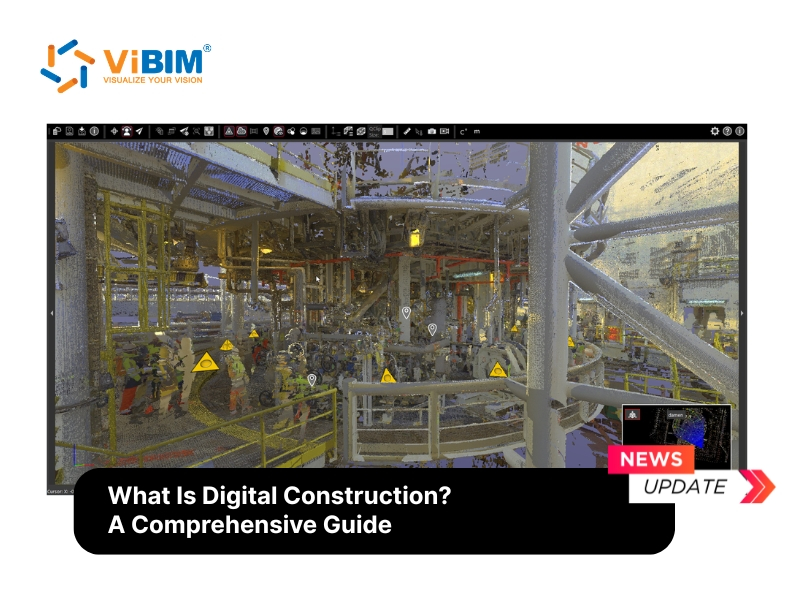
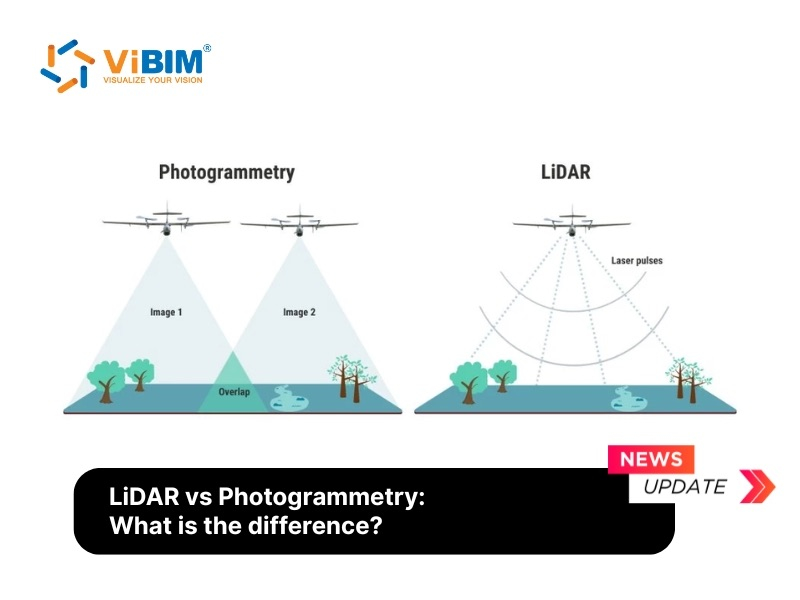
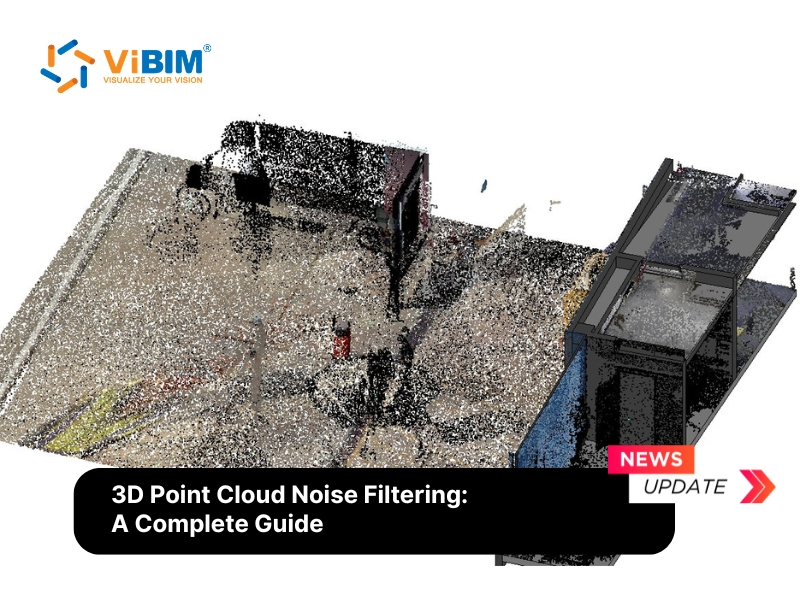
A 3D point cloud model is a massive collection of individual points, or vertices, plotted within a three-dimensional coordinate system (X, Y, Z). Each point represents a single measurement taken on the surface of the object. Captured directly by 3D scanners through technologies like LiDAR (Light Detection and Ranging) or photogrammetry, a point cloud is the raw, unprocessed output of a scan. The choice between lidar vs photogrammetry affects the density, accuracy, and characteristics of the resulting point cloud data. It is not a “shape” in the traditional sense but a dense cloud of data points that, when viewed together, form a recognizable image of the scanned object. This raw data can also contain additional information, such as color (RGB) and intensity values for each point.
- Key characteristics: Point clouds have several defining features that stem from their nature as raw scan data:
- High Accuracy: They offer an extremely precise digital record of the as-built conditions, often with millimeter-level accuracy.
- No Surfaces: A point cloud is a collection of millions of disconnected dots. It does not have continuous surfaces, meaning it is not a “solid” model.
- Data-Rich but Unintelligent: Each point contains a wealth of data (X, Y, Z coordinates, color, intensity). However, the data is “unintelligent” because the software does not inherently understand the relationships between points—it doesn’t know that a set of points forms a wall or a pipe.
- Common file formats: .rcp, .rcs, .e57, .pts, .las, .xyz
Those characteristics are what a modeler works against when converting a 3D point cloud model into usable geometry.
What is a 3D Mesh Model?
A 3D mesh model is a digital representation of an object in three dimensions, built from interconnected vertices (points), edges (lines connecting vertices), and faces (polygons, most commonly triangles or quadrilaterals). Together, these elements define the object’s geometry, shape, and surface detail. The most common types of polygons used are triangles (a triangulated mesh) or quadrilaterals (a quad mesh). This process, known as surface reconstruction or triangulation, interprets the spatial relationship between points to create a continuous, solid-looking surface.
A mesh model is created by processing point cloud data using surface reconstruction and triangulation, where adjacent points are connected into polygons to form a continuous 3D surface. This is one of several approaches to converting a point cloud to 3D model, each suited for different project requirements:
- Key characteristics: Mesh models are optimized for usability and visual representation.
- Lighter File Size: They are significantly smaller and more manageable than the massive point cloud datasets they originate from.
- Has Surfaces: A mesh has a defined, continuous surface, which makes the object appear “solid” and tangible.
- Editable: The model is a single, coherent geometric object that can be easily sculpted, smoothed, modified, and textured.
- Good for Visualization: The solid surface is visually intuitive and can be textured for realistic renderings, making it ideal for applications like VR, animation, and marketing.
- Common file formats: .obj, .stl, .fbx, .ply, .3ds

Neither format is something a design team can build from directly. ViBIM point cloud BIM modeling services turn the raw cloud into Revit geometry covering architectural, structural and MEP elements, delivered as .RVT, .IFC or .DWG at the LOD the project calls for.
Point Cloud vs. Mesh: A Direct Comparison
The following table provides a direct comparison of the 10 key distinctions between point cloud and mesh models:
| Feature | 3D Point Cloud Model | 3D Mesh Model |
| Core Component | Individual, disconnected 3D points (vertices). | Vertices, Edges, and Faces (polygons) that form a surface. |
| Data Structure | Unstructured; a massive list of coordinates. | Structured; defines relationships between vertices to form polygons. |
| Data Type | Raw measurement data; a direct digital twin. | Interpreted geometry; an optimized representation of the raw data. |
| Dimensional Accuracy | Extremely high; represents the true as-built state. | Potentially reduced; accuracy depends on the meshing algorithm and detail level. |
| File Size | Very Large (Gigabytes to Terabytes). | Optimized (Megabytes to Gigabytes), often a 90%+ reduction from the point cloud. |
| Visualization | A collection of dots/points. | A solid, continuous, and often textured surface. |
| Editability | Limited to filtering, segmenting, or deleting points. | Highly editable; allows for sculpting, smoothing, texturing, and modification. |
| Primary Function | Measurement, analysis, and as-built verification. | Visualization, simulation, animation, 3D printing, and digital applications. |
| Rendering Demand | High computational cost; difficult to render smoothly. | Low computational cost; optimized for real-time rendering in GPUs. |
| Hardware Requirement | High RAM and CPU power needed to process large datasets. | Standard GPU and CPU are sufficient for most models. |
Advantages and Disadvantages of Point Cloud and Mesh
Point Cloud Models
Pros:
- High Accuracy: Provides a precise digital record of an object or environment as it exists in reality.
- Detailed Geometry: Captures fine details and complex geometries that might be lost in simplification.
- Raw Data Representation: Serves as an unaltered “digital twin,” perfect for verification and historical archiving.
Cons:
- Large File Sizes: Datasets can be enormous, making them difficult to store, transfer, and work with.
- Processing Power Required: Requires powerful hardware (high RAM and CPU) to load and navigate the data.
- Not Visually Intuitive: Can be difficult to interpret visually as it lacks solid surfaces.
- Lacks Surface Information: The model is not “solid,” making it unsuitable for applications like 3D printing or VR.

Mesh Models
Pros:
- Visually Realistic: Provides a solid, continuous surface that is easy to understand and can be textured for realism.
- Smaller File Size: Significantly more lightweight and manageable than point clouds.
- Well-defined Structure: The polygonal structure is ideal for animation, simulation, and 3D printing.
- Easier to Manipulate: The model is a single, editable object that can be sculpted, modified, and repaired.
Cons:
- Potential Loss of Detail: The meshing process can smooth over or average out fine details present in the original scan.
- Complexity of Mesh Generation: Creating a clean, accurate mesh from a dense or noisy point cloud can be a complex and time-consuming task. Proper 3D point cloud noise filtering before meshing directly impacts the quality and accuracy of the final surface model.

Practical Applications: When to Use Which Model
The choice between a point cloud and a mesh model depends entirely on the end goal of your project.
Applications of Point Cloud Models
Point clouds are the go-to choice when precision measurement and analysis are the primary objectives.
- As-Built Verification: Comparing a point cloud of a constructed site against the original BIM design to check for deviations.
- Construction Monitoring: Tracking progress and quality control on a job site by regularly scanning and analyzing the data.
- Clash Detection: Overlaying point clouds of existing conditions with proposed designs to identify potential conflicts before construction begins.
- Facility Management: Creating a precise digital record of a building’s assets for maintenance and operations.
- Historical Preservation: Archiving historical sites and artifacts with maximum accuracy and detail.
- Forensics and Surveying: Capturing precise measurements of crime scenes or land topography.
For outdoor, terrain, or city-scale work, a lidar point cloud to 3d model workflow preserves georeferenced survey data for the required 3D output.
Applications of Mesh Models
Mesh models are essential when the final output is a visual, interactive, or physical object.
- Virtual Reality (VR) and Augmented Reality (AR): Creating immersive environments and digital objects for training, visualization, and gaming.
- 3D Printing and Additive Manufacturing: Providing the necessary solid, “watertight” geometry required for physical production.
- Animation and Video Games: Serving as the base models for characters, environments, and props that need to be textured and animated.
- Reverse Engineering: Creating an editable CAD model from a scan of a physical part to reproduce or modify it.
- Marketing and Visualization: Generating realistic renderings and virtual walkthroughs of architectural designs or products.
- Digital Prototyping: Creating and testing digital versions of products before physical manufacturing.

How to Convert Point Clouds into Intelligent BIM Models?
While point clouds provide an accurate digital record of as-built conditions, they are often considered “unintelligent” data because they lack specific building entity attributes. To maximize value for project management, this raw data must be converted into a structured and information-rich BIM model.
ViBIM specializes in professional Scan to BIM services, transforming complex point clouds into intelligent Revit models. Teams that already hold the scan data but have no in-house Revit capacity use our 3D Revit BIM modeling services to cover the conversion end to end. We go beyond merely creating surfaces (meshes); we develop high-accuracy BIM entities—including Architectural, Structural, and MEP (Mechanical, Electrical, and Plumbing) systems—ensuring every detail is captured with precision.
Why Do Clients Choose Scan to BIM Services at ViBIM?
- On-Time Delivery: Reliability is our competitive advantage, with 99% of our projects completed exactly as scheduled.
- Fast Turnaround Time: Our optimized workflows and advanced technology consistently deliver results up to 30% faster than industry standards.
- High Accuracy & Reliability: Every project undergoes a rigorous, two-layer independent quality check (QC) process to ensure models meet the highest accuracy standards and comply with established US & UK industry benchmarks.
- Responsive Communication: We understand the value of your time. Our experts respond to inquiries promptly, whether during business hours, in the evening, or over the weekend.
Ultimately, point clouds and meshes are not competitors but rather two stages of the same 3D data workflow. The point cloud is the foundational, high-fidelity capture of reality, indispensable for tasks requiring precise measurement and analysis. The mesh model is the optimized, application-ready evolution of that data, perfect for visualization, interaction, and fabrication. Understanding these core differences allows AEC professionals, designers, and engineers to select the right tool for the job, ensuring that their digital models are not only accurate but also perfectly suited for their intended purpose.