3D Point cloud segmentation is the process of grouping points in a 3D point cloud into distinct clusters based on specific attributes. This enables the classification of real-world elements such as walls, floors, pipes, and furniture from the dense, unstructured data captured by laser scanners. This crucial step transforms a chaotic collection of millions of data points into organized, meaningful information. Without effective segmentation, creating an accurate and intelligent Revit model would be an inefficient, time-consuming, and error-prone task.
This article will explore the importance of point cloud segmentation, delve into its different types and techniques, and highlight its key applications in delivering high-quality Scan to BIM projects.

Why is Point Cloud Segmentation Crucial for As-Built Revit Models?
Point cloud segmentation is crucial for as-built Revit models because it enables the division of large, complex 3D point cloud data into meaningful, manageable segments that represent individual building components such as walls, floors, ceilings, and mechanical systems, ensuring the creation of accurate and intelligent 3D models rather than just visual representations.
The impact of point cloud segmentation on the final Revit model is profound, offering several key advantages:
- Improves modeling precision by isolating architectural, structural, and MEP components from dense point cloud data.
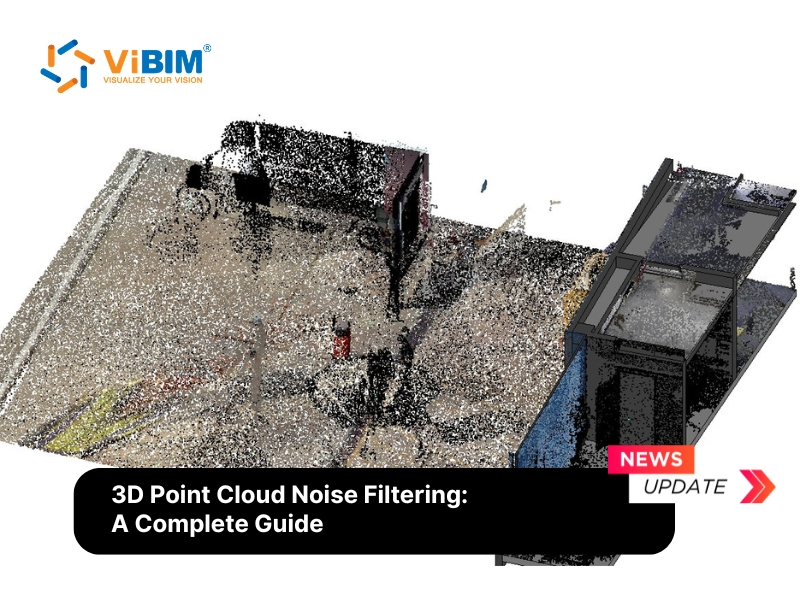
- Reduces manual rework by automatically filtering noise, redundant points, and irrelevant scan elements. Effective 3D point cloud noise filtering before segmentation ensures cleaner input data and higher model accuracy.
- Accelerates BIM production by classifying building objects before importing into Revit, enabling faster family creation revit for specific architectural and MEP components.
- Enhances collaboration by delivering a cleaner, more structured dataset that supports seamless design validation and coordination.
- Encourages BIM modeling automation by enabling comprehensive classification of point cloud data, paving the way for Scan to BIM automation workflows, reducing implementation costs, and fostering broader BIM adoption.

What Are the Different Types of 3D Point Cloud Segmentation?
Point cloud segmentation can be approached in several ways, each offering a different level of detail and classification to suit various project needs. Point cloud segmentation is divided into four main types, and which one a Scan to BIM team runs is a production decision tied to the deliverable it has to hand over, not just a technical preference.
3D Point Cloud Semantic Segmentation
Semantic segmentation is the foundational process of assigning a meaningful, class-level label to every single point in the cloud. Each point is categorized into a predefined class, such as ‘wall’, ‘floor’, ‘ceiling’, ‘door’, or ‘pipe’. This method doesn’t distinguish between individual instances of the same class; for example, all chairs are simply labeled ‘chair’. This type of segmentation is a fundamental step toward creating an intelligent BIM model, as it provides the contextual understanding needed to convert geometric points into categorized building elements. For our modelers, this first labeling pass decides which points become a wall, a floor, or an MEP run in the Revit deliverable.

Point Cloud Object Segmentation (or Instance Segmentation)
Instance segmentation (also known as object segmentation) identifies and differentiates individual objects, even if they belong to the same semantic class. For example, instead of labeling all chairs as ‘chair’, this method would identify them as ‘chair-1’, ‘chair-2’, and ‘chair-3’.
This level of detail is crucial for applications like renovation planning, asset management, and facility management (CAFM/BIM FM), where tracking and managing individual assets is a primary requirement. On a facility-management deliverable, this is what lets us tag each unit as a separately scheduled object the owner can query in the model, rather than one anonymous block of points.

Point Cloud Panoptic Segmentation
Panoptic segmentation is a sophisticated method that combines the strengths of both semantic and instance segmentation. It simultaneously assigns a class label to every point (like semantic segmentation) and identifies each unique object instance (like instance segmentation). This provides a comprehensive, holistic understanding of the scanned environment, offering both broad categorization and specific object identification within a single, unified process. We reach for it on dense mixed scenes such as a plant room, where the deliverable needs both the element classes and every individual asset counted.
Point Cloud Boundary Segmentation
Boundary segmentation focuses on identifying the edges and contours of objects within the point cloud. By detecting sharp changes in the data, this method effectively outlines the boundaries between different surfaces and elements. This is particularly useful for accurately defining the geometry of architectural features, ensuring that elements like walls, windows, and doors are modeled with precise dimensions and clean intersections in the final BIM model, which is what keeps an as-built set dimensionally trustworthy on site.
Segmentation is the step before modeling, not the deliverable itself. ViBIM point cloud to BIM modeling services pick up from the classified cloud and hand back .RVT, .IFC or .DWG at the LOD the project calls for, with every element checked against the scan.
Point Cloud Segmentation Techniques
Various computational techniques are employed to perform the types of segmentation described above. These algorithms analyze the point cloud’s properties, such as geometry, color, and intensity, to group points into meaningful clusters. This analysis typically takes place after a successful point cloud registration process, which ensures all individual laser scans are unified into a single, cohesive coordinate system. None of these techniques run themselves. A trained modeler chooses the method, tunes it to the specific scan, and checks the output, because the same algorithm that cleanly isolates a wall on one dataset can merge it into the floor on a noisier one.
Region Growing Algorithms
Region growing is a popular technique that starts with initial “seed” points and iteratively expands to include neighboring points that share similar properties (like surface normal or curvature). The process continues until no more points can be added to the region, effectively “growing” a complete segment, such as a flat wall or a cylindrical pipe.
This method is appreciated for its simplicity and intuitive nature, making it easy to apply in practice. However, its effectiveness is strongly influenced by the choice of seed points and the tuning of threshold parameters. Handling concave geometries and objects with heterogeneous features can present additional challenges, limiting its overall robustness. In practice a modeler sets the seed points and thresholds by hand and reviews each grown region, since a mis-set threshold quietly bleeds one surface into the next.

Clustering Algorithms
Clustering algorithms group points based on their proximity and density. Methods like K-means or DBSCAN partition the point cloud into clusters, which can represent individual objects or components. This technique is effective for separating distinct, non-connected objects in a scene, such as furniture or equipment.
However, their performance depends on assumptions about cluster shape, density, and separation, which may not align with real-world conditions. Noise and uneven point densities can negatively affect their accuracy and reliability. Our team picks the method and its parameters per scene and checks the clusters against the scan, because automatic clustering routinely splits one object into two or fuses two into one.
Graph-Based Methods
Graph-based methods transform irregular 3D point clouds into a graph representation, where each point acts as a node and edges connect neighboring nodes based on spatial proximity. This approach captures the complex spatial relationships within the data, enabling advanced algorithms such as normalized cuts, random walks, and conditional random fields (CRFs) to extract semantic clusters that correspond to objects.
While these methods are highly effective in modeling detailed structures, their main drawback lies in the computational cost of building and processing full graph representations, especially for large-scale point clouds. Even when the graph resolves fine structure, a modeler still verifies that the extracted clusters map to real building elements before any of it is modeled.

Deep Learning-based Approaches
The most advanced technique involves using deep learning, a subset of artificial intelligence, which has achieved state-of-the-art results on many point cloud segmentation benchmarks. Instead of relying on predefined geometric rules, different neural network architectures have been developed to consume and extract features directly from unstructured 3D point clouds. These AI-driven models are trained on vast datasets of pre-labeled scans to automatically identify and classify objects with remarkable accuracy, even in complex and cluttered environments.
Key deep learning architectures include:
- PointNet: This pioneering architecture was one of the first to directly process raw point sets using multilayer perceptrons (MLPs) and max pooling. Its strength lies in preserving the original geometric detail without converting the data, though it can be limited in modeling local context between points.
- PointNet++: As an evolution of PointNet, this model introduces hierarchical feature learning. By applying principles from CNNs, it groups points into neighborhood sets to better capture local context and relationships, leading to more robust segmentation.
- Convolutional Neural Networks (CNNs): These networks operate on voxelized (3D grid) versions of point clouds, which allows them to apply standard 3D convolutions. However, the process of converting point clouds into voxels can sometimes result in a loss of fine detail due to quantization.
- Graph Convolutional Networks (GCNs): These methods treat the point cloud as a dynamic graph, performing convolutions that incorporate contextual information from neighboring points to understand complex relationships and structures.
In general, deep learning methods excel at learning high-level semantic features from point data for highly accurate segmentation. While they often have significant computational requirements, their ability to automate the segmentation process is set to reshape the Scan to BIM industry. Even so, state-of-the-art models still mislabel cluttered, occluded, or unusual areas, so at ViBIM every automated segmentation passes human QC before it becomes a modeled element.
Put together, segmentation is where a scan stops being a cloud of points and starts becoming named building elements, and it is skilled, checkable work rather than a one-click filter. ViBIM has refined this stage across more than 250,000 hours of Scan to BIM delivery, running two independent QC passes, one for geometry and one for parameters, at LOD 100 through LOD 500, so a mislabeled duct or a wall merged into a slab is caught before it reaches your model.
Classified output also has to survive the handover, so point cloud file formats that preserve per-point labels are worth confirming before the scan leaves the surveyor.
Applications of Point Cloud Segmentation in Scan to BIM projects
Point cloud segmentation in Scan to BIM projects is crucial for creating accurate models by identifying and separating different building components from raw scan data. By automatically classifying and segmenting point clouds into semantic categories, it significantly improves the efficiency and accuracy of the point cloud Scan to BIM workflow from existing conditions. Here are key applications:
Detection and Reconstruction of Building Elements
The primary application of segmentation is to automatically detect and reconstruct distinct building elements from the raw point cloud. This forms the basis of the as-built model through professional point cloud data modeling techniques.
- Walls, Slabs, and Ceilings: Segmentation algorithms are crucial for identifying the primary structural components. By analyzing point normals and density within a height histogram, these techniques can accurately delineate horizontal planes (floors, ceilings) and vertical surfaces (walls), even in complex, non-orthogonal building layouts.
- Doors, Windows, and Openings: Once wall planes are identified, segmentation is used to detect voids and openings. Histogram-based methods and template matching algorithms can recognize the typical dimensions and aspect ratios of doors and windows, separating them from the solid wall structure.
- Rooms and Zones: With walls and slabs defined, segmentation enables the creation of enclosed volumes representing individual rooms and zones. By analyzing wall intersections, the software can form closed polygons that define room boundaries, which is essential for extracting area parameters and assigning functional attributes.
- MEP and Functional Components: Advanced auto-segmentation can isolate other critical assets within a facility, such as equipment, columns, structural frames, and complex MEP systems like pipes and ducts. This is particularly valuable for creating detailed digital twins where specific assets need to be visualized and analyzed independently.

Generation of Simulation-Ready Models
Segmentation makes it significantly faster to generate simulation-ready 3D models directly from scan data. Instead of converting an entire, heavy point cloud, users can process only specified segmented layers into lightweight polygon data. This targeted approach dramatically reduces conversion time and creates optimized models for collision detection, equipment layout planning, or carry-in/out route studies.
Smarter Visualization and Facility Management
This technology greatly enhances the usability of 3D point cloud data by allowing users to isolate specific objects into separate layers. For example, a facility manager could hide architectural layers to visualize only the MEP system for maintenance planning. This enables easier visualization of changes, such as how a space would look after a piece of equipment is removed, simply by hiding the corresponding layer. These segmented clouds can also be converted into lightweight, textured 3D polygon models, which are ideal for virtual simulations and are far easier to handle in various downstream applications.

From Segmentation To Delivery: Partnering With A Revit BIM Modeling Service Provider
Successfully managing 3D point cloud segmentation is the foundation for a high-quality digital twin. However, the true value lies in how you translate those segments into a parametric environment. Choosing a dedicated Revit BIM modeling service provider allows you to convert complex point cloud data into information-rich models with precision and scale.
Why Choose ViBIM For Your Point Cloud To BIM Modeling Services?
At ViBIM, we bridge the gap between reality capture and design. Our specialized point cloud to BIM modeling services are engineered for high accuracy and reliability across architectural, structural, and MEP disciplines. We empower your team with:
- 99% On-Time Delivery: We maintain a strict commitment to your project schedule.
- 30% Faster Turnaround: Optimized workflows and advanced technology reduce implementation costs and save time.
- High Modeling Precision: We use a rigorous two-layer independent quality check (QC) process to ensure model integrity.
- Complimentary Trial Project: We offer a free pilot project to demonstrate our technical capabilities before you commit.
Maximize your project’s ROI by ensuring your segmented data is modeled by industry experts. Contact ViBIM today to discuss your next Scan to BIM requirement and receive a customized quote.
FAQs
What software is used for point cloud segmentation?
Software for point cloud segmentation ranges from open-source tools like CloudCompare to commercial platforms such as Geomagic Studio and PointCab. Selecting the best Scan to BIM software often depends on whether you require manual control or advanced AI-driven segmentation features.
How long does the segmentation process take?
The time required for point cloud segmentation can range from just milliseconds with simple edge-based techniques on small datasets to several hours or even days when applying advanced deep learning models to large-scale data. Processing speed depends on multiple factors, including the complexity of the algorithm, the density and volume of the point cloud, the desired accuracy, and the computational resources available.
ViBIM has been actively researching segmentation – labeling – automate modeling solutions to improve production workflows and enhance model quality. However, practical implementation still faces limitations, especially when applied to real projects with tight schedules, varying standards, complex structural connections, and diverse requirements for detail levels. Our assessment is that, at present, this technology can support a portion of the overall Scan-to-BIM workflow, rather than replacing the role of expert specialists entirely.

This article has provided a comprehensive overview of point cloud segmentation and its indispensable role in Scan-to-BIM projects. We have explored the importance of transforming raw data into meaningful components, detailed the different types of segmentation, and examined the various computational techniques like Region Growing and Deep Learning. Mastering these concepts is not only crucial for optimizing workflows but also for unlocking the immense potential for automation and accuracy in the AEC industry.