BIM maturity levels are a standardized framework used to measure the degree of collaboration and sophistication of information management within an AEC project. This model provides a clear and progressive roadmap for organizations, helping them benchmark their current processes and plan their journey toward complete digital transformation. This progression charts the industry’s evolution from relying on basic 2D drawings and fragmented communication to leveraging fully integrated, lifecycle-managed digital assets. Understanding these levels is essential for any firm aiming to enhance efficiency, reduce risk, and remain competitive in an increasingly digital landscape.
This article will explain each of the four primary levels of BIM maturity (0, 1, 2, and 3), benefits of adopting higher BIM maturity levels, and clarify the crucial role of the modern ISO 19650 international standard in this framework.
What are BIM Maturity Levels?
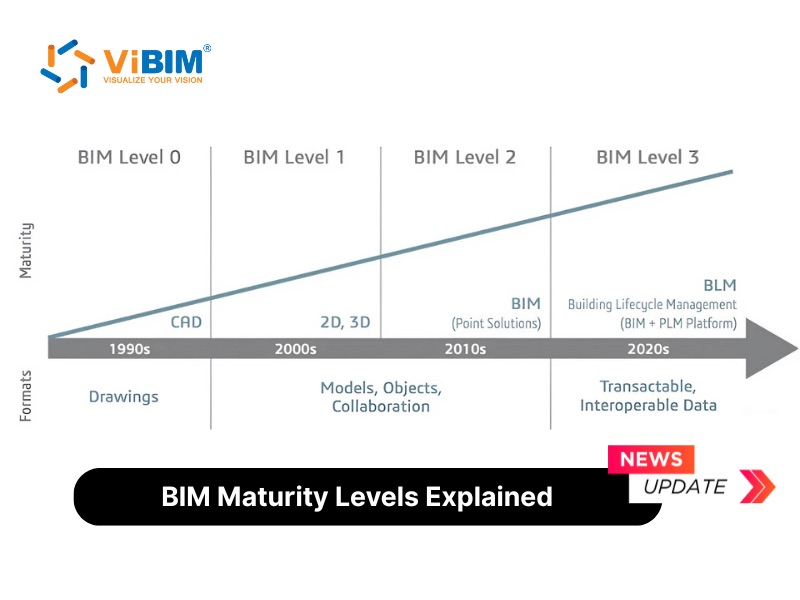
BIM maturity levels are best understood as key milestones for measuring the level of BIM adoption in a project, organization, or the construction industry.
This evolution was famously visualized in the Bew-Richards model, often depicted as a triangle or wedge, which originated in the UK and has since influenced global standards. The primary goal of this framework is to define a clear progression of technological adoption, evaluating the degree of collaboration and information sharing between all project stakeholders.
The key ingredients that define BIM maturity include:
- Collaboration: The level of connectivity and data exchange between project teams work. This evolves from no collaboration at Level 0 to real-time, integrated collaboration at Level 3.
- BIM Data Management: The level at which BIM models are used to create, visualize, and manage digital information about the building throughout its entire lifecycle.
- Lifecycle Integration: This defines the level at which BIM data is integrated across the different stages of the building’s lifecycle, from design and construction through to operation and maintenance.
The relevancy of this model grew exponentially in 2011 when the UK’s “Government Construction Strategy” made it mandatory for all centrally procured public projects to comply with BIM Level 2 by April 2016. This government initiative was designed to drive widespread BIM adoption, aiming to increase the efficiency, collaboration, and data management of construction projects to make them more time- and cost-effective.
The Four Main Levels of BIM Maturity
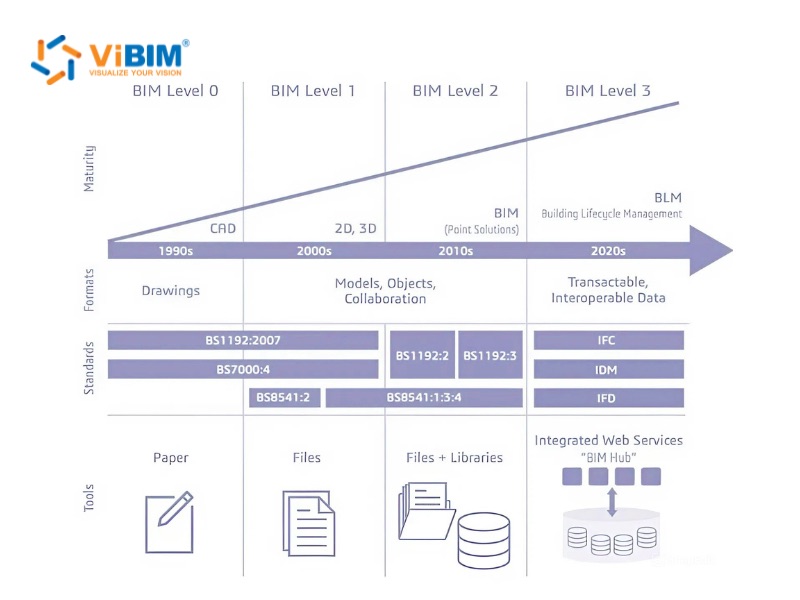
The BIM maturity model is broken down into four distinct levels: 0, 1, 2, and 3. Each level represents a significant step up from the last, not just in terms of the technology used but, more importantly, in the processes and collaborative capabilities of the project team.
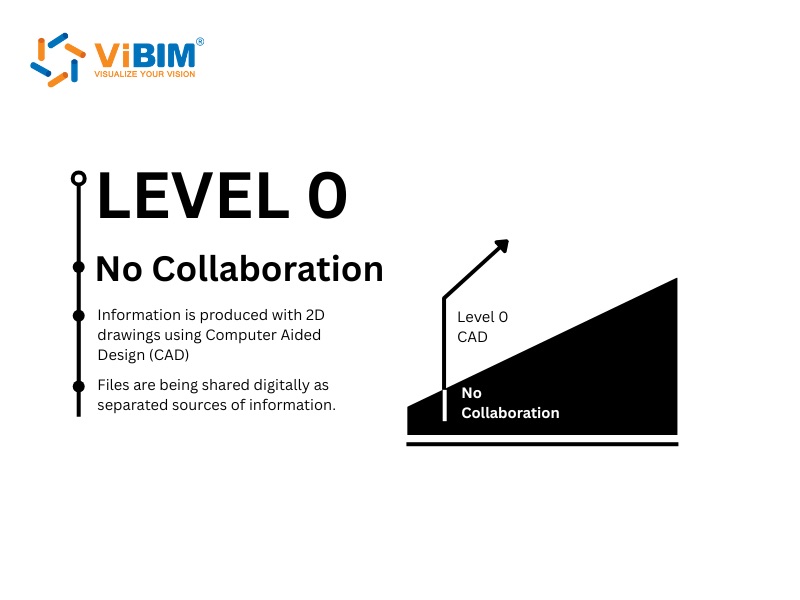
BIM Level 0: No Collaboration
BIM Level 0 means that the project promotes zero collaboration and makes use of traditional 2D CAD drafting techniques. At this foundational stage, the main goal is to generate Production Information in the form of paper or electronic prints, with information shared as individual, unmanaged files. Moving off that baseline means converting 2D CAD to BIM, a project in its own right rather than a byproduct of new software. There is no digital representation of the building’s physical and functional characteristics and no centralized data exchange, as each discipline works in complete isolation. This lack of integration between different project phases results in an increased potential for errors and rework.
As the most basic stage, it is now considered an obsolete practice that the industry has largely moved beyond.
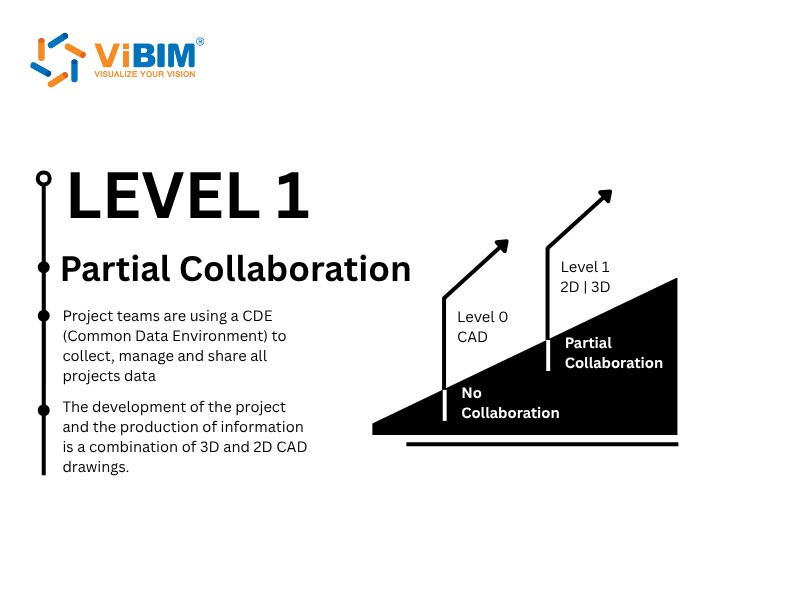
BIM Level 1: Partial Collaboration
BIM Level 1 marks the first significant step toward a true BIM methodology. This stage is focused on managing the transition from basic CAD information to a mix of 2D and 3D data. While conceptual work often moves into 3D modeling, production information and statutory approvals are still frequently managed with 2D drawings. Also, the CAD standards are governed under British Standards (BS 1192:2007). Effective governance at this stage requires a comprehensive bim execution plan that defines the project protocols and deliverables for all stakeholders.
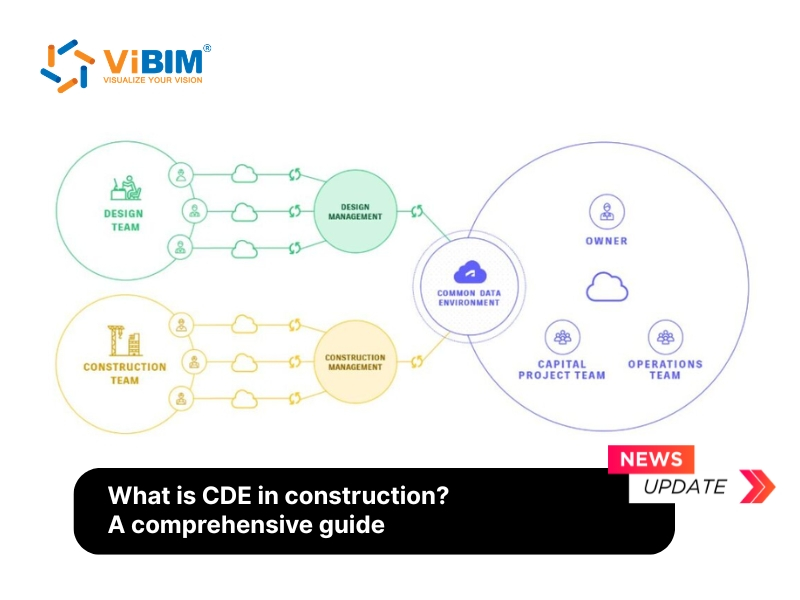
The key requirement introduced at this level is the Common Data Environment (CDE). A CDE is a centralized online repository where all project information is stored and shared. However, at Level 1, models are not typically distributed among all stakeholders for collaborative development, leading some to call this stage “lonely BIM.” Each discipline creates and manages its own data, but a shared platform is now in place.
BIM Level 2: Full Collaboration
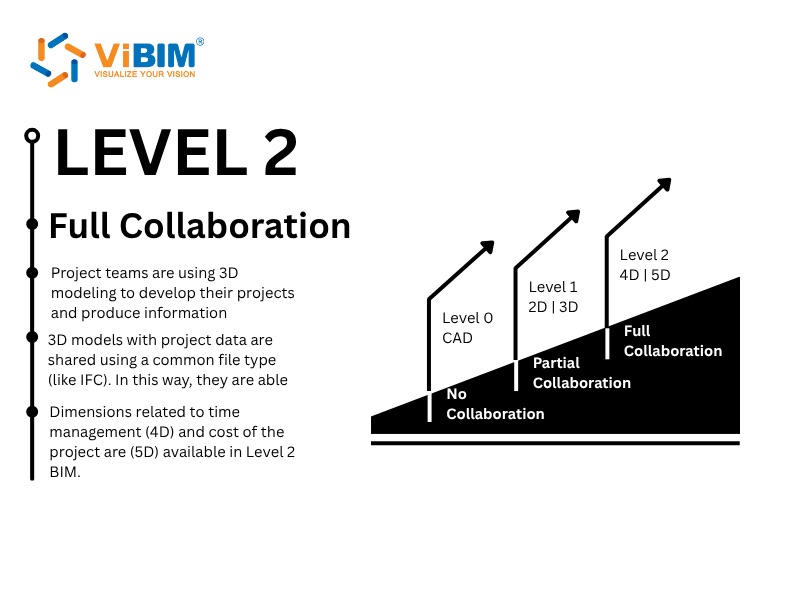
BIM Level 2 is defined by full collaboration between all project parties. While each discipline still maintains its own distinct 3D model, these models are combined into a “federated” model within the CDE. This federated model allows for comprehensive clash detection and design review, as all components can be viewed in a single, coordinated environment. The key to Level 2 is the seamless exchange of information using open, non-proprietary file formats like IFC and COBie.
This stage is defined as “full collaboration,” as all project parties work together using their distinct models within the CDE. This level was mandated by the UK government for all centrally-funded public projects by 2016 and now forms the basis for international standards like ISO 19650. It is at this level that 4D BIM (time and scheduling) and 5D BIM (cost estimation) become fully feasible.
BIM Level 3: Full Integration
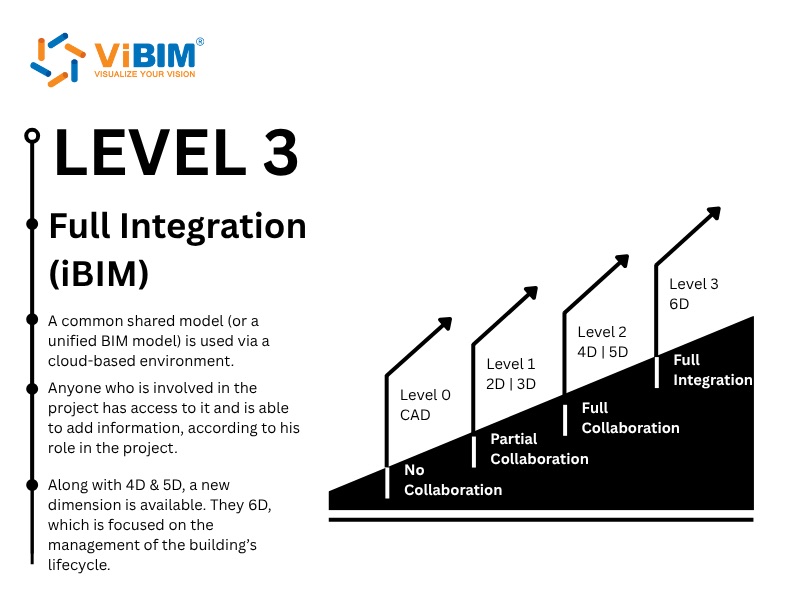
BIM Level 3 represents the ultimate goal for the construction sector: the full integration of all project information within a single, cloud-based environment. At this stage, the concept of separate, federated models is replaced by a single, shared project model accessible to all participants simultaneously.
This unified approach removes the final layer of risk for data conflicts, as any modifications are updated in real-time for everyone to see. This workflow relies on “Open data” and Open BIM principles, where the IFC format is fundamental to ensuring maximum interoperability between different software platforms. Furthermore, this stage fully encompasses the entire building lifecycle, from initial design through operations, maintenance, and eventual disposal, enabling advanced applications like 6D BIM (sustainability) and 7D BIM (facility management).
Benefits of Adopting Higher BIM Maturity Levels
Moving up the BIM maturity levels is not just about adopting new technology; it is about transforming business processes to unlock tangible project and business benefits. Each step forward offers progressively greater value:
- Improved Communication and Collaboration: A shared understanding of the project reduces misunderstandings, leading to fewer errors, conflicts, and costly rework.
- Enhanced Project Visualization and Clash Detection: Integrating models at Level 2 allows for the early detection and resolution of clashes between systems (e.g., plumbing hitting structural beams), saving time and money during construction.
- Greater Cost and Time Predictability: The data-rich models at Level 2 and above enable accurate quantity takeoffs for 5D cost estimation and sequencing for 4D construction planning.
- Better Quality Control and Data Consistency: Working from a CDE ensures that all team members are using the most up-to-date and consistent information, improving the overall quality of the final building.
- Increased Competitive Advantage: Firms that can operate at higher maturity levels are better positioned to win projects, especially as more clients and government bodies mandate BIM Level 2 or iso 19650 certification compliance.
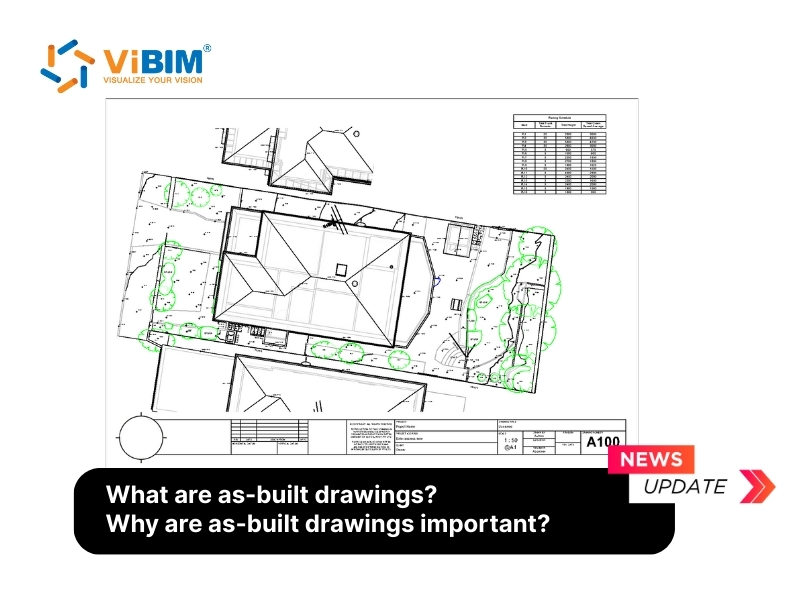
These advanced advantages build upon the foundational value BIM delivers. Most of that value shows up long before Level 2, in fewer clashes on site, faster approvals, and drawings that match what was actually built. Reaching Level 2 and beyond is not only about process. It also depends on the quality of the models being exchanged, because collaboration breaks down when the underlying data is inconsistent. It is why ViBIM produces standards-compliant as-built models from point cloud data, giving teams a verified foundation to build their collaborative workflows on.
The Future: BIM and the ISO 19650 Standard
The principles established in the UK’s BIM Level 2 framework have proven so effective that they have been adopted and formalized into a global standard: the ISO 19650 series. This set of international standards provides a unified framework for managing information over the entire life cycle of a built asset using Building Information Modeling. In essence, ISO 19650 takes the core collaborative processes of BIM Level 2 and makes them accessible for the entire global AEC market, ensuring a consistent approach to BIM implementation worldwide and solidifying a new generation of BIM standards.
BIM Maturity Levels vs. BIM Dimensions vs. Levels of Development (LOD)
In the world of BIM, several terms are used to describe different aspects of the process. They sound interchangeable in a meeting, but each one answers a different question about the project. It’s important to distinguish between maturity levels, BIM dimensions, and levels of development (LOD). Teams mix these up most often when writing a scope of work, and the cost of the mix-up is real, because a contract that asks for Level 2 maturity when what the project actually needs is levels of development in BIM at LOD 350 changes both the deliverable and the price.
| Concept | Definition | Example |
| BIM Maturity Levels | A framework that measures the degree of collaboration and data exchange maturity in a project or organization. | Level 2 BIM, where separate disciplinary models are combined into a federated model for collaboration. |
| BIM Dimensions | A way of classifying the types of data that can be added to a BIM model beyond the 3D geometry. | 4D BIM adds time/scheduling data, 5D BIM adds cost data, and 6D BIM adds facility management data. |
| Level of Development (LOD) | A scale that specifies the level of detail and reliability of the information within a BIM model at different project stages. | LOD 300, where a model element is graphically represented with specific quantities, size, shape, and location. |
FAQs
Is there a universal standard for BIM maturity levels?
While the four-level model (0-3) is widely recognized, its initial development was largely driven by UK standards like the PAS 1192 series. The international ISO 19650 series now provides a global framework for information management using BIM, effectively standardizing the principles of what was known as UK BIM Level 2 for a worldwide audience.
What is the main barrier to reaching higher maturity levels?
The primary barrier is often not technology but culture and process. Reaching BIM Level 2 and beyond requires a significant cultural shift from siloed, adversarial working relationships to open, collaborative ones. Technical integration also presents hurdles, when retrofitting existing structures. Other major challenges include the initial investment in software and hardware, the cost and time required for comprehensive staff training, and the difficulty of establishing standardized, repeatable processes that work seamlessly across different organizations and supply chain partners.
The journey through the BIM maturity levels is a strategic imperative for any organization in the AEC industry looking to remain competitive and efficient. It is a path from isolated work to integrated collaboration, from simple drawings to intelligent data, and from costly uncertainty to predictable, high-quality outcomes. By understanding where your organization stands and planning a clear path forward, you can unlock the full potential of Building Information Modeling.
Reaching higher maturity levels begins with an expertly built model. At ViBIM, Our Revit BIM modeling services provide the accurate, collaborative foundation you need to achieve true Level 2 integration.