ISO 19650 is the international standard that tells project teams how to create, name, share, and hand over building information at every stage of a built asset’s life. Where the BIM definition explains the model and its use, ISO 19650 governs the information inside and around it, so the right data reaches the right people in a form they can trust. It grew out of the UK’s BS 1192 and now applies to projects worldwide.
The standard matters because a modern project runs on information, not geometry alone. When every party works to the same rules, models and documents move between them with less rework and stay traceable from the first design through to final handover. ISO 19650 removes the guesswork over who owns which data and when it is due, so a delivery team that ignores it hands over files the client has to rebuild before they are usable.
Its framework rests on a set of clear principles, a strict naming convention, and a series of six parts, and it defines exactly how information moves through a project’s delivery phase. For teams weighing its benefits, moving on from the older PAS 1192, or working between US and international projects, understanding ISO 19650 is what keeps a model reliable from design through to operation.

What Is ISO 19650?
ISO 19650 is the global standard for managing project information throughout the entire lifecycle of a built asset, from design and construction into operation. The standard defines the information clients and asset owners need, the methods for sharing it, and the timeline for each exchange, so project teams coordinate accurately at every stage. It grew out of the British Standard BS 1192, which first introduced a unified structure for managing information across project stages, and was later expanded into a full international standard.
A model produced to ISO 19650 arrives named, structured, and versioned to a shared rule set, so it drops into the shared project data environment instead of being reworked to fit.

Why Is ISO 19650 Important?
ISO 19650 is important because it removes the ambiguity that causes most information failures on a project: who produces which data, in what format, and by when. When every party works to the same rules, information stays consistent and traceable from design through handover, and each piece of data has a clear owner. That accountability also cuts the disputes that arise when files are inconsistent or cannot be traced back to a source.
Compliance with the standard is a qualification requirement on many UK public-sector and international projects, so following the ISO 19650 framework often decides whether a delivery team can bid at all. The same discipline moves organisations toward higher BIM maturity and leaves asset owners with reliable data they can operate from for the building’s entire lifecycle.
What Is the Concept Behind ISO 19650?
The concept behind ISO 19650 is the information delivery cycle, a process that moves data from initial requirements through to fulfilment while keeping it reliable and traceable at every step. The information delivery cycle runs through three connected stages, listed below.
- Specification (defining the need): Organisational and asset requirements are translated into project-specific needs and embedded in the Project Information Model (PIM), giving delivery teams a measurable target.
- Production (creating and managing information): Delivery teams create information under the BIM Execution Plan (BEP), organised inside the common data environment.
- Acceptance (review and handover): All information is reviewed, validated, and approved; the PIM then matures into the Asset Information Model (AIM), marking the shift from delivery to operation.
In practice, this keeps digital information at the foundation of project delivery, ready to support decisions long after handover.
What Are the Principles of ISO 19650?
ISO 19650 is built on four principles that govern how information is structured and shared: cascading information requirements, a defined information management function, federation instead of integration, and the common data environment. The four principles are described in turn below.
Cascading Information Requirements
Information requirements in ISO 19650 cascade from an organisation’s strategy down to a specific project, rather than being set at a single level. The requirements cascade through three levels, listed below.
- Organisational Information Requirements (OIR): what an organisation must know to make long-term strategic decisions about the assets it owns or operates.
- Asset Information Requirements (AIR): the detailed data needed to answer the OIR, shaping how each asset is monitored and maintained.
- Project Information Requirements (PIR): the project-specific data that answers the OIR and AIR, guiding design and construction teams.
Cascading this way keeps the information produced during delivery tied to the asset’s purpose and the organisation’s strategy.

Defined Information Management Function
ISO 19650 assigns a formal information management function to the project team, so responsibility for handling data is clearly owned rather than left to chance. This function identifies who leads information management, describes how the delivery team will meet project requirements, and maintains oversight throughout delivery. Job titles may differ between teams, but the principle keeps accountability clear and reduces overlap between roles.
Federation Instead of Integration
ISO 19650 uses federation rather than integration, so each discipline keeps its own model and all models are combined only when coordination is needed. Architecture, structural, and building-services teams each develop their model independently, using their own methods and data standards.
The separate models are brought together into a unified view only when coordination is required, without ever merging into a single file. This keeps each specialist in control of their own accuracy and is a practical application of open BIM.
Common Data Environment (CDE) as a Single Source of Truth
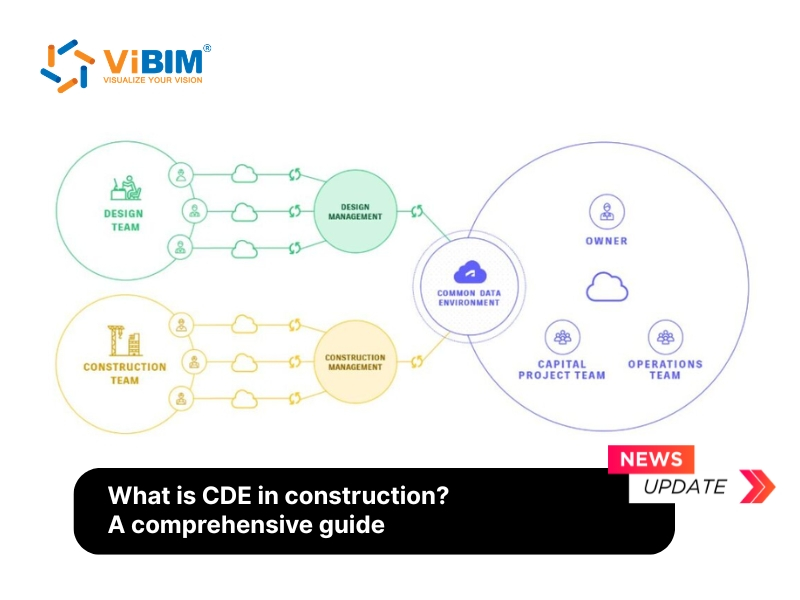
The common data environment, or CDE, is the single agreed source of information for a project, and it sits at the centre of how ISO 19650 controls information delivery. The CDE manages every information container, from models and drawings to schedules and smaller data units such as layers and symbols. Information moves through four controlled stages inside the CDE, listed below.
- Work in Progress (WIP): information under active development.
- Shared: information released for reference or coordination by other teams.
- Published: information formally reviewed and approved as part of the official record.
- Archived: information retained for record-keeping and future reference.
Because everyone works from the same trusted source, collaboration improves and duplication and errors fall, while the CDE enforces data security and quality from start to finish.

What Is the ISO 19650 Naming Convention?
The ISO 19650 naming convention is a structured coding system that gives every information container a unique, consistent name, so any file can be identified, sorted, and trusted across the whole project team. The name is built from a set of fields defined by each country’s National Annex and separated by a delimiter. Two extra codes travel with every container: a suitability status (work in progress, shared, or published) and a revision, so anyone can see a file’s stage and version at a glance.
A typical container name is built from the fields below.
- Project and originator: which project the file belongs to and who created it.
- Functional and spatial breakdown: the volume or system, and the location such as level.
- Form and discipline: the type of information and the team responsible.
- Sequential number: a running count that keeps each container unique.
Example (UK National Annex): PROJ1-VBM-XX-00-M3-A-0001, where PROJ1 is the project, VBM the originator, XX-00 the spatial location, M3 the form (a 3D model), A the discipline, and 0001 the sequential number.
Consistent naming means files sort predictably, nothing is lost, and every team member knows a file’s status without opening it. Because the name carries this metadata, models delivered to ISO 19650 arrive as labelled, version-controlled containers rather than loose files a client has to rename and sort.
What Are the Parts of the ISO 19650 Series?
The ISO 19650 series is split into six parts, each covering a different stage or aspect of managing information across a built asset’s lifecycle with BIM. The six parts of the series are listed below.
- ISO 19650-1 sets out the concepts and principles that underpin the whole series.
- ISO 19650-2 covers the delivery (construction) phase, where most information is produced.
- ISO 19650-3 covers the operational phase, guiding how data supports use and maintenance.
- ISO 19650-4 defines information exchange, setting criteria for consistent data validation.
- ISO 19650-5 takes a security-minded approach for sensitive or high-value projects.
- ISO 19650-6:2025 is the latest part, covering health and safety (H&S) information.
Part 2, the delivery phase, is where most project teams meet ISO 19650 first.
What Is the Delivery Phase According to ISO 19650?
The delivery phase in ISO 19650 is the stage where information is produced and handed over, and it separates the appointing party, usually the client, from the appointed parties who deliver the work. Information must flow in a structured, traceable way between them, so roles and duties stay clear from the first request to project close-out. The standard defines eight steps for delivering information, listed below.
- Assessment and need: the appointing party defines what information must be produced and exchanged.
- Invitation to tender: delivery teams are invited to submit their approach and plans.
- Tender response: teams respond with their proposed BIM Execution Plan and supporting detail.
- Appointment: contracts set the scope, timelines, and responsibilities.
- Mobilisation: resources, tools, and systems are prepared for delivery.
- Collaborative production of information: data is produced in the CDE, checked, reviewed, and approved before sharing.
- Information model delivery: approved models and structured data, including schedules such as CoBie, are delivered for validation and client use.
- Project close-out: final information is handed over, converting the PIM into the AIM.
Each step connects to the next, maintaining transparency and shared accountability across the delivery phase.


How Does ISO 19650 Affect BIM?
ISO 19650 turns BIM from a model-based process into a structured information-management system that spans the entire lifecycle of an asset. Traditional BIM often focuses on visual representation and overlooks how information is organised and exchanged. As one of the most critical international BIM standards, it gives geometry and embedded data equal weight, so teams decide from verified information rather than visuals alone.
The standard also formalises how information is shared by setting exchange points that align with project milestones. At each point, known as Exchange Information Requirements (EIR), every team defines what data is needed, when it is due, and the level of detail required. These checkpoints push teams to prioritise accuracy and review before anything is shared.
Beyond construction, ISO 19650 extends BIM into ongoing asset management. Data produced in early stages is formatted for direct use in operation and maintenance, connecting design and build with how the finished asset is run. That continuity is what lets a common data environment keep serving the owner long after handover.
What Are the Benefits of Following ISO 19650?
Following ISO 19650 delivers both practical and strategic gains: less rework, clearer responsibility, and reliable data owners can operate from for the asset’s whole life. Standardised information exchange keeps communication consistent across every stage of design, construction, and operation. The main benefits of following the standard are listed below.
- Lower costs: standardised exchange reduces rework and saves time across delivery.
- Better collaboration: structured communication keeps multidisciplinary teams in sync.
- Higher predictability: defined workflows make project outcomes easier to forecast.
- Fewer legal disputes: clear documentation and duties cut the risk of claims.
- Simpler handover: a clean data flow prevents the loss of critical information between phases.
- Better data quality: reliable, accurate information supports faster decisions.
- Stronger risk management: a consistent data structure tightens control over project risks.
- More room to innovate: standardised practice creates a stable base for process and technology gains.
These gains only materialise when the underlying model and data are accurate, which is also what moves a firm toward higher BIM maturity.
How Does ISO 19650 Relate to PAS 1192?
ISO 19650 is the international successor to the UK’s PAS 1192 series, carrying its core ideas forward while replacing a national scope with a global one. PAS 1192 was a UK specification that first set out how to manage BIM information, and ISO 19650 turned that thinking into an international standard any country can adopt.
Much of it carried over unchanged, including the common data environment and the work-in-progress, shared, and published states. What changed is the terminology, the global scope, and the way the standard now sits inside the wider UK BIM Framework. For organisations that once worked to PAS 1192, the move is more a transition than a fresh start.
Why Does ISO 19650 Matter for US Firms?
Although ISO 19650 began in the UK, US firms adopt it because it aligns with international project requirements and complements the National BIM Standard (NBIMS-US) rather than replacing it. US firms most often meet the standard on international or cross-border projects, such as a US engineering firm delivering on a UK or Middle East project where ISO 19650 compliance is written into the contract. In those settings it gives teams a shared way to exchange information with partners who follow different national practices.
Rather than competing with NBIMS-US, which guides US practice, ISO 19650 adds an information-management layer that firms apply when they need interoperability across borders. For a US firm, the value is fewer coordination errors and less friction when collaborating with international teams.
How ViBIM Applies ISO 19650 in Scan-to-BIM Delivery
At ViBIM, every Scan-to-BIM project follows the information-management discipline ISO 19650 defines, so clients receive named, version-controlled containers instead of loose files. We deliver models through a common data environment on Autodesk Construction Cloud (ACC), exchange them in the open IFC schema (IFC2x3 or IFC4), and run two independent QC passes that check geometry, parameters, and deviation before anything reaches the client.
Those deliverables stay compatible with ISO 19650, PAS 1192, and the BIM Forum LOD specification, and our founder contributed to Vietnam’s first national BIM guidelines in 2017. The same standards shape every model produced through our point cloud to BIM services.
Frequently Asked Questions About ISO 19650
What Sizes of Organization Use ISO 19650?
ISO 19650 applies to organisations of all sizes, from small teams to large corporations, because its framework adapts to the demands of each project. Civil engineers, asset owners, and facility operators all use it to manage building information in an organised way. Projects range from a single building to entire portfolios of government and commercial property, as well as infrastructure such as roads, rail, and bridges.
What Are the Requirements of ISO 19650?
The ISO 19650 series sets out how information is managed from specification through to delivery across a project’s lifecycle. It establishes expectations for planning, tendering, appointment, mobilisation, and execution so information stays consistent and traceable. Responsibilities vary by role: the appointing party manages demand-side tasks, the lead appointed party coordinates as the main contractor, and an appointed party delivers information as a supplier.
How Does My Organization Start Implementing ISO 19650?
Implementing ISO 19650 starts with understanding and preparation, including buying and studying the standard. Teams then review their processes, roles, and activities against ISO 19650 principles to gauge readiness. The final step is certification, which involves scheduling an assessment and completing a two-stage audit of systems and documentation.
What Is ISO 19650 Certification?
ISO 19650 certification is an independent assessment confirming that an organisation’s information-management processes meet the standard. It is awarded to an organisation after a two-stage audit, not to an individual model or project. A delivery team can produce work to ISO 19650 conventions without holding organisational certification, so it is worth checking which one a project actually requires.
ViBIM focuses on Revit BIM Modeling services using point cloud data, specialising in Scan to BIM projects through Revit and Autodesk platforms. We support building surveyors, as-built documentation, and design or engineering phases. Contact ViBIM today to discuss your project requirements and get a free quote.
Vietnam BIM Consultancy and Technology Application Company Limited (ViBIM)
- Address: 10th floor, CIT Building, No 6, Alley 15, Duy Tan street, Cau Giay ward, Hanoi, Vietnam
- Phone: +84 944 798 298
- Email: info@vibim.com.vn