A BIM Execution Plan (BEP) is a project-specific document that defines how Building Information Modeling will be created, managed, and shared across a construction project, and it is also known as a BIM Implementation Plan. It turns a complex digital process into a clear, collaborative workflow, so architects, engineers, contractors, and owners all work from the same playbook and contribute to one coordinated model. Because the plan fixes the standards, level of detail, and deliverables a project expects up front, the BEP a client sets decides what every modeling team, in-house or outsourced, must actually deliver.
A complete BEP brings together a handful of core components, from project goals and a responsibility matrix to information exchanges and quality control. It comes in two types, a pre-contract BEP prepared before the contract is awarded and a post-contract BEP that governs delivery, and it takes shape through an eight-step process that moves from understanding the project to setting deliverables and quality checks. The sections below also cover how a BEP aligns with ISO 19650, what a BEP template includes, and the common mistakes that undermine one.

What Is a BIM Execution Plan (BEP)?
A BIM Execution Plan is the foundational document a project team agrees on before modeling begins, setting the processes, standards, and responsibilities for delivering BIM across a project’s lifecycle. BEP stands for BIM Execution Plan, and on some projects the same document is called a BIM Implementation Plan, a BIM Project Execution Plan, or, on infrastructure work, a digital engineering execution plan.
Building Information Modeling brings a project’s data into one shared model, and the BEP is what keeps that model coherent when many firms contribute to it. The plan is usually led by the BIM Manager or BIM Coordinator, with input from the architects, engineers, contractors, and the owner who will rely on the output. It is written at the start of a project, before the first model is built, so every discipline works from the same rules.
A BEP settles four things in particular: the roles and responsibilities of each party, the scope and level of detail of the information to produce, the collaborative processes teams will follow, and the software and standards that tie the work together. It normally responds to the client’s Employer’s Information Requirements (EIR), the document an owner uses to state what it expects from BIM on the project.
Why a BEP Matters
A BEP matters because it turns a project’s BIM ambitions into an agreed, accountable workflow, so every team works from the same standards, roles, and deliverables instead of assumptions. Without it, each firm reads the model its own way, and the gaps surface late, when they are expensive to fix.
The main benefits of a well-structured BEP are the following:
- Alignment on goals. Every party understands the project’s BIM objectives and ties its work to the owner’s priorities.
- Clear accountability. The plan assigns BIM roles and responsibilities to each organization and named team member, usually through a responsibility matrix.
- Consistent standards. It fixes the technical standards, levels of BIM maturity, LOD targets, and the mechanisms for sharing models and exchanging data.
- Lower risk. A more integrated design and construction process carries less risk than traditional, siloed practice.
- Contract-ready language. The BEP provides specific wording that can be written into contracts so every participant meets its BIM obligations.
- A measurable baseline. It sets a benchmark to track progress against, plus metrics that inform future projects.
Because a BEP fixes the LOD targets, file conventions, and deliverable formats a project expects, it is also the brief a provider of Revit BIM outsourcing services works to.
Key Components of a BEP
The key components of a BEP cover the project’s people, goals, standards, information exchanges, and quality controls, from the responsibility matrix through to the final deliverables. The exact layout can be tailored to a project, but a robust plan addresses the same core areas.
A well-built plan typically documents the following components:
- Project overview and information. The reason for the plan, plus the project name, number, address, scope, and key milestone dates.
- Key project contacts. A directory of personnel with each stakeholder’s BIM role, from the BIM Manager to the discipline modelers.
- Project goals and BIM uses. The strategic goals and the specific BIM uses chosen to meet them, such as design coordination, clash detection, quantity takeoff, and facility management.
- Roles and responsibilities. A responsibility matrix that spells out who owns each BIM task and deliverable.
- BIM process design. Process maps that show how information is created and handed between teams at each stage.
- Information exchanges. The model elements, the level of development, and the level of information required at each milestone, down to the difference between LOD 300 and 350 where that distinction changes what a team hands over.
- Facility data requirements. The owner’s data needs for operations and maintenance, often exchanged through COBie.
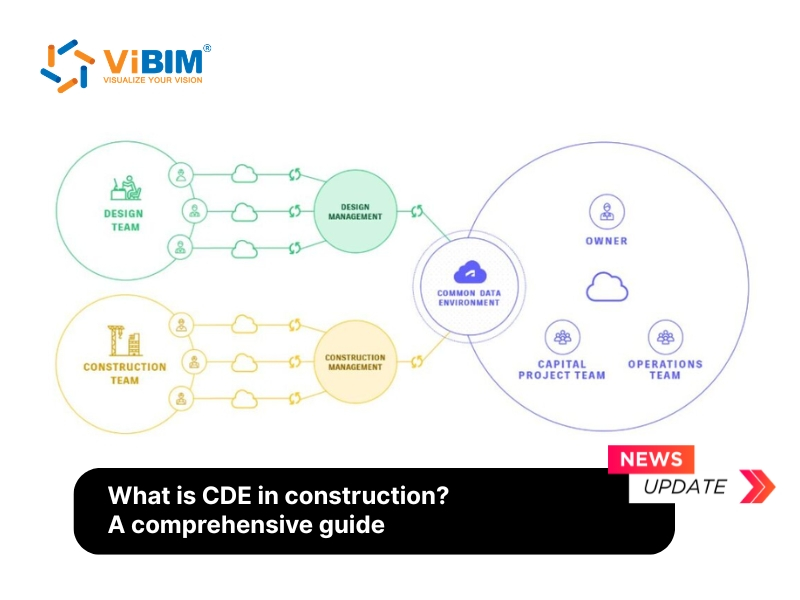
- Collaboration procedures. Model-management protocols, file structures, meeting schedules, and the common data environment (CDE) where information lives.
- Model quality control. The checks that confirm every model meets the agreed standard before it is shared.
- Technology and model structure. The hardware, software, naming conventions, and coordinate system the project runs on.
- Deliverables and delivery strategy. The specific outputs due at each stage and the contractual delivery method that governs them.
The plan should make explicit the difference between LOD 300 and 350 wherever that threshold changes the agreed handover scope.
The illustration below maps these components onto a single view of a BEP.

Types of BIM Execution Plans (Pre-Contract vs Post-Contract)
BIM Execution Plans come in two types, a pre-contract BEP prepared before the contract is awarded and a post-contract BEP developed by the appointed team once work begins. The two share a purpose but differ in who writes them and how much detail they carry.
The table below summarizes how the two BEP types differ:
| Pre-Contract BEP | Post-Contract BEP | |
|---|---|---|
| When | Before the contract is awarded, during tender | After the contract is awarded |
| Who writes it | The bidding supplier or design team | The lead contractor with the full team |
| Purpose | Show capability and respond to the EIR | Confirm and fix the workflow for delivery |
| Contents | Proposed approach, capability, high-level standards | Responsibility matrix, MIDP and TIDP, detailed QA/QC |
The pre-contract BEP answers the client’s Employer’s Information Requirements (EIR) by showing how a bidder would meet them. Once the contract is signed, the post-contract BEP adds the detail that runs the job, including the Master Information Delivery Plan (MIDP) and the Task Information Delivery Plans (TIDPs) that state what information each team will deliver and when. These plans, and the pre- and post-contract split itself, follow the structure set out in ISO 19650.
How a BEP Aligns with ISO 19650
Under ISO 19650, the international standard for managing information in BIM, the BEP is the delivery team’s response to the client’s information requirements, split into a pre-appointment and a post-appointment plan. The standard governs how information is created, shared, and stored, and the BEP is where those principles become a concrete workflow.
ISO 19650 frames the same two stages a project already recognizes as pre- and post-contract. The pre-appointment BEP demonstrates capability, much like a pre-contract plan, while the post-appointment BEP sets out the detailed commitments and workflows the team will follow after award. Both sit within a chain of information requirements: the owner’s organizational and asset information requirements (OIR and AIR) inform the exchange information requirements, which ISO 19650 uses as the formal name for the EIR, and the BEP responds to them. This is also where a project fixes the contract language that binds each party to its BIM obligations.
Working to a recognized set of BIM standards is what makes a BEP portable between teams. We deliver models to ISO 19650, PAS 1192, and BIM Forum LOD conventions, so the requirements a client writes into a BEP carry straight through to handover.
How to Create a BIM Execution Plan (Step by Step)
Creating a BIM Execution Plan follows a systematic sequence, from understanding the project to setting the standards, deliverables, and quality checks every team agrees on before modeling starts. It is a collaborative effort, so the earlier stakeholders are involved, the smoother the plan runs.
Follow these steps to build a BEP:
- Understand the project. Review the owner’s requirements, the project brief, and any existing documents to pin down scope, complexity, and constraints.
- Define goals and BIM uses. Set SMART objectives, for example cutting coordination clashes by 20% through clash detection, then choose the BIM uses that support them.
- Set roles and a responsibility matrix. Assign who creates, coordinates, reviews, and approves each part of the model, and record it so nothing is left unowned.
- Define communication and the CDE. Schedule coordination meetings, agree the data-exchange procedures, and set up a common data environment (CDE) where all information lives.
- Develop the BIM execution strategy. Map the workflow for each phase, from design through construction to handover.
- Select software and IT. Specify platforms, versions, and hardware so files stay compatible across disciplines.
- Determine deliverables and a timeline. State what is due, in what format, from whom, and by when.
- Establish quality control. Define the model checks, clash-detection routines, and data-validation steps that keep the information reliable.
Beyond these steps, treat the BEP as a living document and revise it as the project evolves.
The diagram below outlines the planning procedure these steps follow.

Source: BIM Project Execution Planning Guide – Version 2.2
BIM Execution Plan Template and Example
A BIM Execution Plan template is a pre-structured document that lays out every required section, from project information and roles to information exchanges and quality control, so a team fills in project-specific detail instead of building the structure from scratch. Teams rarely start from a blank page, and a good template gives the process a head start.
Most templates in use today trace back to two sources: the National BIM Standard-United States (NBIMS-US) BEP Standard, which ships a spreadsheet template and an information-exchange schema, and the Penn State BIM Project Execution Planning Guide, the reference much of the industry builds on. A pre-contract template stays high level, capturing approach and capability, while a post-contract template carries the full responsibility matrix, delivery plans, and QA/QC detail. Whichever you start from, tailor it to the project, because copying another project’s plan unchanged is one of the most common mistakes teams make.
The example below shows the layout of a typical BEP template.

Source: BIM Project Execution Planning Guide – Version 2.2
Common Mistakes to Avoid When Creating a BEP
The most common way a BIM Execution Plan fails is not a missing section but a plan that is vague, copied, or never updated, so it quietly stops guiding the team. Knowing the usual pitfalls is the first step to avoiding them.
Watch for these common BEP mistakes:
- Unclear or unrealistic objectives. Goals, BIM uses, and scope are left fuzzy, so no one can tell whether the plan is working.
- Lack of stakeholder involvement. The plan is written in isolation, without input from the clients, consultants, and subcontractors who have to follow it.
- Ambiguous roles. No one is clearly accountable for a given BIM task, and work falls through the gaps.
- Insufficient standardization. Naming conventions, data-exchange formats, and QC protocols are missing, so models drift apart.
- An overly complex or inflexible plan. A document buried in jargon or locked down too tightly cannot adapt when the project changes.
- Treating it as static. The plan is never revised, or copied wholesale from another project without tailoring.
- Skipping quality control. No QA/QC process is set for the model or the data exchanges, and errors surface at handover.
Most of these pitfalls trace back to wider mistakes in BIM implementation, from leadership gaps to technology misalignment.
The graphic below summarizes the mistakes to watch for.

BEP FAQs
Common questions about BIM Execution Plans are answered below.
What Does BEP Stand For in BIM?
BEP stands for BIM Execution Plan. It is the document that defines how BIM will be created, managed, and shared on a project, and who is responsible for each part.
What Is the Difference Between a BEP and an EIR?
The difference between a BEP and an EIR is direction. The Employer’s Information Requirements (EIR) state what the client needs from BIM, and the BEP is the delivery team’s response showing how it will meet those needs.
Who Prepares a BEP?
The BIM Manager or BIM Coordinator usually prepares the BEP, with input from the architects, engineers, contractors, and the client. On a post-contract plan, the lead contractor coordinates it across the full team.
What Is a BEP in Revit?
A BEP is not a Revit feature but a plan Revit teams follow. It sets the templates, naming conventions, LOD targets, and shared-parameter standards modelers apply inside Revit, so files from different people stay consistent.
Is a BEP Required for Every Project?
Any project using BIM should have a BEP. Without one, teams tend to hit miscommunication, inconsistent modeling standards, and avoidable delays, whatever the project’s size.
How Often Should a BEP Be Updated?
A BEP should be treated as a living document and updated throughout the project. Best practice is to review it at the start of each major phase, such as schematic design, design development, and construction, and whenever the scope, key personnel, or software changes.
Final Thoughts on BIM Execution Planning
A well-structured BIM Execution Plan is the foundation of a successful project. It aligns stakeholders, standardizes workflows, and turns the potential of BIM into predictable delivery. Define the goals, roles, and standards early, and the rest of the project has a clear roadmap to follow.