The AEC industry is undergoing a profound transformation, driven by BIM. This process, which involves creating and managing digital representations of physical and functional characteristics of places, is fundamentally changing how buildings are designed, constructed, and operated. A critical component of this evolution is Scan to BIM—the process of using 3D laser scanners to capture as-built conditions and convert that point cloud data into an intelligent BIM model.
As we look toward 2026 and beyond, the Scan to BIM workflow is no longer just about capturing static geometry. It is becoming a dynamic, intelligent, and highly automated process. Emerging trends powered by Artificial Intelligence (AI), cloud computing, and digital twins are setting new standards for accuracy, efficiency, and collaboration, reshaping project lifecycles from start to finish. In this article, ViBIM provides a detailed glimpse into what the future holds, enabling professionals to stay informed and prepared for the next wave of Scan to BIM developments. Through this, you can gain insights into how these technologies reshape workflows, reduce manual effort, and improve project outcomes, while understanding the emerging directions of this technology.

Global market and adoption trends shaping scan to BIM
Market expansion continues to shape the Scan to BIM landscape, and the 3D scanning sector is estimated to surpass $16 billion by 2030, growing at more than 4.5% CAGR between 2024 and 2030, while interest in Scan to BIM has steadily increased over the last three years, as illustrated in the trends graph below. Investment in hardware, software, and AI-driven workflows contributes to higher adoption and wider implementation across diverse construction and renovation projects globally.

Regional adoption also highlights the varied pace of integration, with North America currently holding the largest market share, accounting for more than 35%, while the Asia-Pacific region shows the fastest growth, currently accounting for 25–30%. Global projects, from Tokyo’s skyscrapers to historical renovations in Rome, demonstrate the technology’s practical application, and leading companies such as Hexagon, Faro, and Trimble drive innovation and set benchmarks in automation, cloud integration, and AI-assisted modeling. These market dynamics are reflected visually in the market share graph below, revealing patterns of growth and the centers of adoption that continue to influence Scan to BIM implementation worldwide.

Market growth says the demand is there; it does not say who will model your building. The Scan to BIM services in USA ViBIM provides are scanner-agnostic, accepting RCP, RCS and E57 data from any capture vendor.
What are the trends in Scan to BIM in 2026?
AI and automation continue to transform Scan to BIM by accelerating point cloud processing and reducing manual modeling efforts. Digital twins also expand the ability to create virtual replicas of buildings for ongoing management and planning. Cloud-based collaboration allows teams across locations to work together seamlessly, and Augmented Reality (AR) enhances visualization and on-site decision-making, helping professionals understand complex designs more intuitively. You can explore each trend in detail to see how they impact accuracy, collaboration, and future adoption in Scan to BIM projects.
The AI/ML revolution in scan-to-BIM workflows
One of the most significant trends is the application of Artificial Intelligence (AI) and Machine Learning (ML) to the point cloud processing workflow. Traditionally, converting raw point cloud data into intelligent, classified BIM objects (like walls, pipes, and columns) is a time-consuming and labor-intensive manual task. However, the rise of Scan to BIM automation is drastically reducing this workload by enabling algorithms to handle repetitive modeling tasks with greater speed.
AI enhances automation in object classification, clash detection, and model generation, reducing manual effort and improving accuracy across project stages. Additionally, AI-powered tools offer up to 25–30% efficiency gains and support predictive analytics, sustainability, and generative design. By 2024, 68% of architectural firms are expected to explore or implement AI-driven solutions.
AI and ML algorithms are now being trained to automate this process. These systems can:
- Pattern identification: Advanced AI algorithms scan point clouds to detect recurring geometric forms, distinguishing architectural features such as walls, columns, floors, and ceilings, and isolating irregular shapes like mechanical equipment, reducing reliance on manual judgment.
- Object classification: AI categorizes point clusters into meaningful building components, such as beams, pipes, ducts, and windows, using extensive pre-trained datasets. These elements improve consistency and minimize human error.
- Database matching: Recognized elements are compared with parametric libraries containing dimensions, material properties, and construction data, ensuring the digital model closely mirrors real-world conditions.
- Parametric BIM object generation: The system produces fully parametric objects with metadata, rules, and functional properties, enabling downstream design, analysis, and facility management applications.
- Spatial context establishment: Objects are accurately positioned in 3D space with defined relationships and connectivity, creating an integrated BIM environment that supports precise simulations, clash detection, and lifecycle management.

Digital twins empowering dynamic Scan to BIM
A digital twin is a real-time digital replica of a physical asset, system, or process that reflects its current state and simulates behavior over time, enabling monitoring, testing, and operational optimization. Digital twins combine BIM data with live sensor and IoT inputs, producing continuously updated models that support predictive maintenance, energy efficiency, and occupant comfort. This integration of real-world data and digital modeling allows operators to anticipate issues, test solutions virtually, and optimize building performance across its lifecycle.
So, how does scanning to BIM link to the digital twin? Scan to BIM forms the basis for digital twins by providing accurate 3D models from point clouds, ensuring that the digital representation mirrors the physical asset. Facility managers can monitor systems in real-time, detect potential problems early, and plan maintenance efficiently. Meanwhile, repeated Scan to BIM surveys capture changes over time, keeping the digital twin current. Integrating energy, water, and environmental data enables buildings to optimize resource use and minimize their environmental impact.
Organizations reported measurable benefits from digital twins. For example, Hexagon noted that 62% of firms experience significant value, especially in predictive maintenance and energy management. AI-powered twins monitor critical systems, such as HVAC and elevators, detecting anomalies early and preventing costly failures. Meanwhile, energy modeling adjusts lighting and climate control based on occupancy and weather, reducing waste. Challenges such as legacy system integration, sensor calibration, and skills gaps exist; however, careful planning can help companies to fully leverage digital twin technology.
To understand the fundamental differences between these two technologies and how they complement each other in modern construction workflows, explore our detailed comparison in digital twin vs BIM.

Cloud collaboration is shaping the new project standard
Cloud-based technology, often referred to as “the cloud,” provides on-demand access to a scalable and flexible pool of computing resources that can be shared among multiple users, allowing self-service provisioning and administration without relying on local servers. Cloud platforms enable architects, engineers, contractors, and owners to simultaneously access, update, and collaborate on BIM models and point cloud data. This technology accelerates decision-making, reduces miscommunications and ensures that design changes or clash detections are reflected immediately for all stakeholders.

The ability to coordinate in real-time brings tangible benefits to project teams through the following four capabilities:
- Real-time collaboration: Cloud-based BIM enables multiple users to work on the same model simultaneously, eliminating the need for file exchanges and preventing confusion over versions. This ensures everyone has up-to-date information, reduces errors, and saves time.
- Increased efficiency and productivity: Centralized, live project data accelerates tasks such as clash detection, design reviews, and coordination, eliminating manual file transfers and supporting faster, more accurate project completion.
- Cost savings: Subscription-based cloud BIM eliminates the need for expensive servers and IT maintenance, offering flexible and budget-friendly solutions, particularly for small and medium-sized businesses that cannot afford to invest in heavy infrastructure.
- Access from anywhere: Cloud-based systems enable professionals to view and edit BIM models from any internet-enabled device, whether on-site, at the office, or working remotely, thereby increasing flexibility and streamlining project management.
However, data security remains a key consideration in cloud workflows. Therefore, finding the best Scan to BIM software that prioritizes security standards is essential for protecting sensitive scanned data. Selecting providers that comply with industry standards, such as ISO 27001 and GDPR, helps protect BIM models from unauthorized access or loss.

Integration with Augmented Reality (AR)
Augmented reality (AR), also known as mixed reality (MR), overlays digital 3D graphics onto real-world environments through devices such as head-mounted displays or handheld screens, blending virtual content with physical surroundings in real-time. AR enables users to interact with digital objects as if they exist in the real world, thereby enhancing visualization, understanding, and engagement across various tasks. Similar innovations are occurring in BIM and VR, where virtual reality offers fully immersive environments for design review before construction even begins.
So, how is augmented reality (AR) taking Scan to BIM to the next level? The integration of AR with Scan to BIM is transforming construction workflows by overlaying BIM models onto physical spaces, enhancing collaboration, problem-solving, and visualization throughout the project lifecycle —from design and planning to construction and maintenance. AR supports on-site measurements, safety monitoring, and real-time modifications while enabling interactive presentations and training, thereby reducing errors, saving costs, and minimizing rework.
Companies such as Entekra, Obos, GAMMA AR, The Wild, Akular, and hsbcad are advancing AR-powered BIM by providing platforms that unify project data, track progress, and facilitate remote collaboration. The combined use of AR and BIM enhances communication among stakeholders, improves safety, facilitates better decision-making, and streamlines project management, making it an increasingly essential tool in modern construction.
This integration is transforming on-site workflows by enabling:
- Design and construction verification: Teams can visually compare the as-built conditions with the design model to instantly identify discrepancies or deviations from the plan.
- Virtual clash detection: Potential clashes between MEP systems and structural elements can be visualized on-site before installation, preventing costly rework.
- Improved facility maintenance: Technicians can use AR to locate hidden pipes, ducts, and electrical conduits behind walls and ceilings, making maintenance safer and more efficient.

What are the challenges in Scan to BIM using AI?
AI-powered Scan to BIM introduces new possibilities for automation and accuracy, but teams face at least four major challenges that must be addressed to make workflows reliable and effective:
- High implementation cost:AI-powered Scan to BIM requires expensive hardware with specialized GPUs, skilled AI researchers, and custom-built software tools. The shortage of experts and lack of ready-made solutions make development and testing costly, while integrating AI workflows further increases overall project expenses. Understanding the full Scan to BIM cost structure is essential for project budgeting.
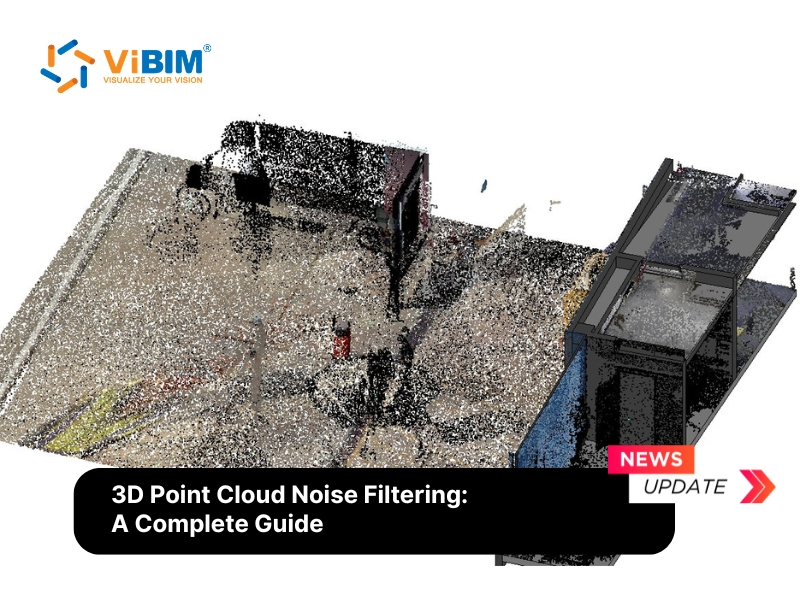
- Data quality and preparation challenges: Raw point cloud data require careful cleaning, alignment, and optimization before AI can accurately interpret them. Issues such as incomplete coverage, registration errors, or noisy scans, which can confuse AI algorithms and lead to inaccurate object recognition.
- Limited training data availability: AI models rely on extensive, labeled datasets of architectural and engineering elements. A lack of sufficient examples can impair recognition performance, which can be addressed by creating standard training datasets, utilizing transfer learning, generating synthetic data, or applying progressive training with verified project outputs.
- Complexity and uniqueness of construction environments: While AI excels at recognizing standard objects, it often struggles with custom-fabricated components, intricate historical architecture, or unique construction assemblies not represented in its training data. These outliers challenge AI’s generalization ability and can reduce model reliability in real-world projects.
- High computational demands: Training and deploying advanced AI models require significant computational power and specialized hardware. This remains a major barrier to entry for smaller firms, limiting widespread adoption despite the technology’s growing potential..
Addressing above four challenges involves five strategic implementation measures, such as:
- Starting with smaller, well-defined projects to gain experience and minimize risk.
- Phasing AI adoption gradually to allow teams to adapt and refine workflows.
- Developing quality control protocols for AI-generated models to monitor accuracy.
- Establishing metrics for tracking performance, efficiency, and ROI of AI usage.
- Creating feedback loops from completed projects to continuously improve recognition and processing accuracy.

The article explored the purpose and applications of Scan to BIM, covering four trends in scan to BIM including AI automation, digital twins, cloud collaboration, and augmented reality. We also highlighted challenges and strategies to overcome them for more accurate, efficient, and cost-effective scan-to-BIM workflows. Each section provided actionable insights that help professionals improve project planning, coordination, and maintenance using point cloud data.
ViBIM focuses on delivering specialized Revit Model Outsourcing from laser scan data, leveraging Revit as the primary authoring tool on the Autodesk platform, and serving building surveyors, as-built projects, and engineering or design workflows, ensuring precise digital models.
Ready to Implement AI-Powered Scan to BIM in Your Projects?
To leverage AI automation, cloud collaboration, and digital twin integration for faster and more accurate as-built modeling, explore ViBIM’s professional Scan to BIM services that combine cutting-edge technology with proven expertise. Contact ViBIM today at
Vietnam BIM Consultancy and Technology Application Company Limited (ViBIM)
- Address: 10th floor, CIT Building, No 6, Alley 15, Duy Tan street, Cau Giay ward, Hanoi, Vietnam
- Phone: +84 944 798 298
- Email: info@vibim.com.vn