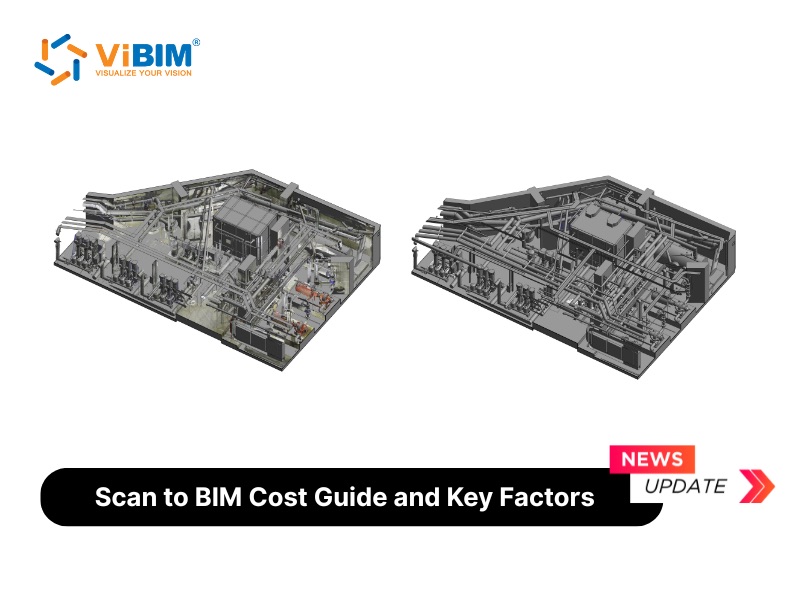
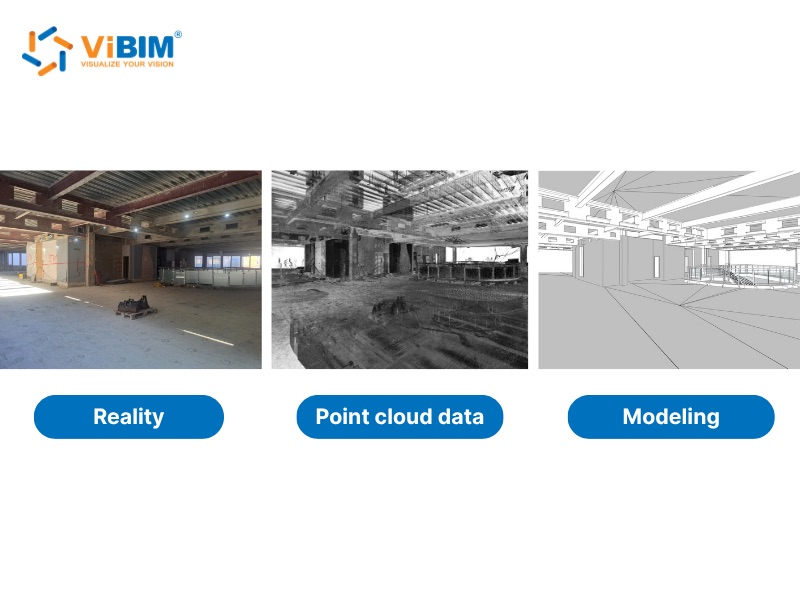
Scan to BIM cost is the total investment required to create a digital building information model from 3D laser scan data. This cost comprises two main phases: the on-site laser scanning and the subsequent 3D point cloud to BIM modeling.
In the U.S. market, the total 3D scan to bim project cost can range from $2,500 to over $200,000. This includes scanning fees (often $2,000-$10,000+) and modeling fees, which can range from $0.50 to over $10.00 per square foot. However, a final price is never fixed; it is always customized based on variables like project size, complexity, and the required Level of Development (LOD).
Understanding these costs is crucial for accurate project budgeting, effective quote comparison, and recognizing the significant return on investment (ROI) that a precision model delivers.
This guide provides a detailed breakdown of the seven key factors that influence your final price, compares common pricing models, and explains how a quality BIM model delivers a positive ROI by eliminating risks and ensuring precision. By the end, you will have the clarity needed to budget your next project with confidence.
How Much Does Scan to BIM Cost?
To determine the cost of Scan to BIM, you must consider two main phases: the initial 3D laser scanning of the site and the subsequent development of the BIM model from the captured point cloud data.
Below are the most common pricing for the two phases:
3D Laser Scanning Costs
In the market, the initial 3D laser scanning phase generally ranges from approximately $2,000 to over $10,000. This price is influenced by several variables, including the type of scanner used, the complexity and size of the site, and the required level of data accuracy and resolution.
3D BIM Modeling Costs
The cost for the 3D point cloud to BIM modeling phase in the U.S. market typically ranges from $2,000 for simple projects to over $20,000 for large, complex assets. Converting the registered point cloud data into a functional BIM model is often the most time-consuming and variable part of the Scan to BIM cost. For this reason, this stage often accounts for the largest portion of the total budget, making it the primary driver of the final project price.
Ultimately, there is no fixed price list for the entire Scan to BIM process. The final cost, combining both scanning and modeling, depends entirely on your project’s specific needs. For example, the total price to scan and model a 5,000 sq ft warehouse will be significantly lower than for a historic church of the same size due to vast differences in complexity.
These variations across both phases are determined by several key variables, which directly influence the required work hours and total price. So, what are the key factors that truly influence Scan to BIM pricing?
What Are the Key Factors That Influence Scan to BIM Costs?
There are seven key variables determine the final price of a Scan to BIM project include:
- 1. Complexity of Architecture and MEP Systems
- 2. Project Size and Scale
- 3. Required Level of Development (LOD)
- 4. Point Cloud Data Quality and Density
- 5. Required Deliverables
- 6. Project Timelines and Urgency
- 7. Experience and Expertise of the Service Provider
These factors influence both the scanning and modeling phases. However, their impact is most significant on the modeling stage, which typically accounts for the largest portion of the total budget. Below are details of the 7 main influencing factors:
1. Project Size and Scale
The most direct factor influencing cost is the building’s total area, measured in square meters (m²) or square feet (sq ft). Larger buildings require more hours to model all architectural, structural, and MEP elements. Verticality also adds complexity; a multi-story building is more costly to model than a single-story structure of the same area due to the need to accurately connect floors, stairs, and vertical systems.
2. Complexity of Architecture and MEP Systems
A building’s complexity directly escalates modeling time and cost. Structures with intricate architectural elements like ornate facades or curved surfaces demand significantly more modeling time than simple designs. Similarly, dense Mechanical, Electrical, and Plumbing (MEP) systems are a primary cost factor. The high density of pipes, ducts, and equipment requires meticulous modeling, which directly increases the project hours.
3. Required Level of Development (LOD)
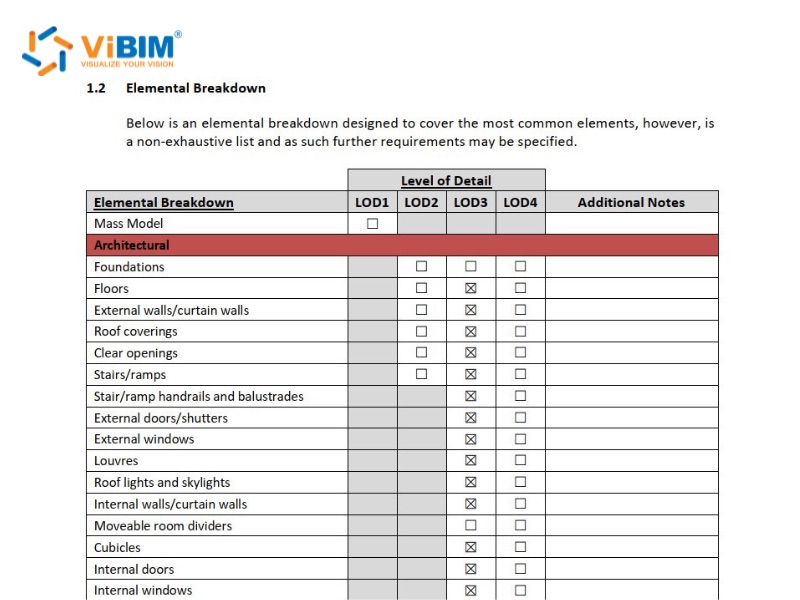
The Level of Detail LOD defines the detail within the BIM model and is a primary price driver. An LOD 200 model shows basic geometry, while an LOD 300 or 350 model provides precise, as-built geometry for construction. Moving from LOD 200 to LOD 300 can increase modeling time by 30-50% for the same area, significantly raising the project’s cost.
4. Point Cloud Data Quality and Density
The quality of the initial data is critical. High-quality, dense point cloud data leads to efficient and accurate modeling. Conversely, low-density data or scans with missing areas require more time for interpretation and manual adjustments, which directly increases the cost. To ensure quality, ViBIM’s 3d BIM Modeling services use pre-processed Autodesk Recap (RCP/RCS) files that maintain the integrity of the original scan data.
5. Required Deliverables
The base deliverable for many Revit modeling services is the native 3D model (e.g., a Revit .RVT file). However, projects often require additional outputs that add to the total cost. These include 2D construction drawings (.DWG), interoperable Industry Foundation Classes (.IFC) files, or models prepared with data for BIM for Facility Management (FM). For teams pricing a scan to BIM Revit project, every additional DWG, IFC, or FM-ready dataset should be scoped as a separate output.
6. Project Timelines and Urgency
Projects with compressed timelines or urgent delivery requirements typically command higher prices. Meeting accelerated schedules often necessitates allocating more resources, implementing overtime work at premium rates, or prioritizing the project over others.
7. Experience and Expertise of the Service Provider
The provider’s level of experience directly impacts the final cost. Firms with specialized expertise in complex areas such as industrial MEP systems, heritage structures, or advanced software workflows typically command higher rates. This premium reflects their efficiency, proven accuracy, and ability to troubleshoot challenges, which prevents costly errors and project delays.
Once these key factors influencing the scope of work are clear, the next step is to understand how quotes for Point Cloud to BIM Services are structured. Each pricing model has its own pros and cons, making it suitable for different types of projects.
For a clear roadmap, consult our guide on how to outsource Revit Modeling to confidently select the right partner and ensure project success.
Common Scan to BIM Pricing Models Explained
Service providers in the AEC industry typically use one of three main pricing models: Per Square Foot/Meter, Hourly Rate, and Fixed Lump-Sum Price.
The comparison table below summarizes the pros, cons, and best-use cases for each, helping you make an optimal choice. The right model for your project will depend on its scope, complexity, and how clearly your requirements are defined:
| Feature | Per Square Foot / Meter | Hourly Rate Model | Fixed Lump-Sum Price |
| Best For | Preliminary budgeting on simple, repetitive projects. | Projects with evolving or unclear scopes. | Well-defined projects with a clear scope of work. |
| Pros | Fast estimates for initial planning. | High transparency; you only pay for time spent. | Complete cost certainty before work begins; no surprises. |
| Cons | Inaccurate for complex projects or high LOD requirements. | Final cost is not known upfront, creating budget uncertainty. | Requires a very detailed and clear scope from the start. |
Per Square Foot / Meter Pricing
This method is used for high-level, preliminary budgeting on simple projects like large warehouses. While it offers a quick cost estimate for initial planning, it often fails to accurately capture the true cost associated with complex buildings, dense MEP systems, or projects that demand a high Level of Development (LOD).
Hourly Rate Model
With the hourly rate model, the final price is based on the actual hours the production team spends to complete the project. This approach offers excellent transparency, as clients pay only for the time invested.
In the U.S. market typical hourly rates for scan to BIM services include:
- 3D Laser Scanning (on-site field work): $150-$500/hour
- Point Cloud Registration & Processing: $75-$150/hour
- Revit BIM Modeling from point cloud: $50-$125/hour
- Basic architectural modeling (LOD 200-300): $50-$75/hour
- Experienced modeling (LOD 300-400): $75-$100/hour
- Complex MEP or specialized work: $100-$125/hour
- Senior BIM Manager/QA Specialist (complex coordination, heritage projects): $100-$175/hour
Example: A mid-sized scan to BIM project requiring 8 hours of point cloud processing at $100/hour and 40 hours of Revit modeling at $75/hour would cost approximately: (8 × $100) + (40 × $75) = $3,800 for the modeling phase alone (excluding initial scanning fees).
This model works best for projects where the scope is not fully defined at the start or is expected to evolve, such as phased renovations or ongoing facility documentation.
Note: Rates vary by geographic location (urban vs. rural), provider expertise, and project complexity. Offshore providers may offer lower rates ($30-$60/hour) but may require additional project management and quality oversight.
Fixed Lump-Sum Price
This is the most common model for projects with a clearly defined scope. A single, fixed price is provided, offering complete cost certainty.
This is ViBIM’s standard model. Our process combines the transparency of an hourly rate calculation with the security of a fixed price. We meticulously estimate the required hours and present a single, all-inclusive lump-sum quote. This approach provides absolute financial confidence, eliminating the risk of budget overruns.
Understanding these pricing models explains how you will be charged. However, to make budgeting more intuitive, let’s review the estimated costs for several common building types to provide a practical basis for comparison.
Estimated Scan to BIM Costs by Building Type
To provide a general overview, here are the estimated lump-sum project costs for common building types in the U.S. market. These figures are broad estimates, as the final price is always customized to your project’s unique requirements.
Small Residential Projects:
- Best For: Homeowners, architects, and contractors working on renovations, extensions, or as-built documentation.
- Typical Scope and Complexity: This category includes properties under 5,000 sq ft, such as single-family homes or apartments. The structure is typically simple, with low complexity and minimal MEP (Mechanical, Electrical, Plumbing) details required.
- Estimated Lump-Sum Cost: A basic LOD 200 model often ranges from $2,500 to $5,000. A detailed LOD 300-400 model, suitable for precise as-built documentation, typically ranges from $5,000 to $8,000.
- Example: A 3,500 sq. ft. single-family home requiring an LOD 300 model of all architectural and structural elements for a renovation project would likely be estimated in the $5,000–$8,000 range.
Medium Commercial Buildings:
- Best For: Business owners, property managers, and developers planning tenant fit-outs, space optimization, or facility upgrades.
- Typical Scope and Complexity: This includes small to medium offices or retail stores (2,500 – 10,000 sq ft). The scope involves modeling the structural layout, major architectural elements, and core MEP systems.
- Estimated Lump-Sum Cost: Basic LOD 200 models for this category range from $8,000 to $15,000. A more comprehensive LOD 300-400 model that includes all visible MEP systems generally costs between $15,000 and $30,000.
- Example: A 7,000 sq. ft. two-story office space needing an LOD 350 model of architecture and MEP for a full tenant improvement project would likely be estimated between $15,000 and $30,000.

Large Industrial or Complex Facilities:
- Best For: Industrial facility managers, civil engineers, and large-scale developers managing complex assets and plant operations.
- Typical Scope and Complexity: This covers large buildings (10,000 – 50,000 sq ft), such as warehouses, factories, or manufacturing plants. These projects are defined by a high density of MEP systems, complex equipment, and intricate structural frameworks.
- Estimated Lump-Sum Cost: Basic LOD 200-300 models generally start between $30,000 and $50,000. Detailed LOD 350-400 models for comprehensive documentation often cost $50,000 to $100,000 or more.
- Example: A 40,000 sq. ft. manufacturing plant requiring an LOD 400 model of all structural steel and dense process piping (MEP) would likely exceed $75,000 due to its high complexity.
Heritage and Historic Preservation:
- Best For: Preservation architects, historical societies, and government agencies tasked with documenting or restoring culturally significant sites.
- Typical Scope and Complexity: These projects are defined by their unique, non-standard geometry. The scope involves meticulously modeling highly intricate features, ornate facades, non-uniform structural elements, and custom ornamentation, which requires high-resolution scanning.
- Estimated Lump-Sum Cost: A basic structural model (LOD 200) might range from $20,000 to $40,000. However, a high-detail LOD 400-500 model required for true preservation and replication can range from $40,000 to over $150,000.
- Example: Modeling a historic church with detailed facades, vaulted ceilings, and intricate ornamentation to LOD 400 standards would be a highly specialized project, with costs likely falling in the $40,000–$150,000+ range.
Highly Specialized Projects (MEP-Heavy):
- Best For: Data center operators, healthcare facility managers, and infrastructure engineers.
- Typical Scope and Complexity: This category includes facilities like data centers, hospitals, tunnels, stadiums, and other MEP-heavy sites. The cost is driven by extreme MEP density (e.g., medical gas, cable trays, specialized HVAC), unique geometry, and the need for exceptionally high accuracy and tolerance.
- Estimated Lump-Sum Cost: Pricing is highly customized. Detailed projects typically start around $40,000–$50,000 and can readily exceed $200,000 for large or exceptionally complex facilities requiring high LODs throughout.
- Example: A full Scan to BIM model of a 25,000 sq. ft. hospital wing, including all layered MEP systems (medical gas, HVAC, electrical) to LOD 400, would be an extensive project easily exceeding $100,000.

Note: These figures are broad estimates and actual costs can vary significantly. Pricing is heavily dependent on your specific project details and also differs depending on the service provider, their pricing structure, and their ability to optimize costs.
While focusing on the initial outlay is essential, the true value of a quality Scan to BIM model lies in its ability to deliver a positive return on investment (ROI). Instead of viewing it as an expense, consider it a strategic investment that prevents risks and optimizes project efficiency.
How Does a Precision Scan to BIM Model Deliver a Positive ROI?
A precision Scan to BIM model delivers a positive return on investment (ROI) by overcoming common Scan to BIM adoption challenges including four key areas: preventing costly rework, optimizing coordination through clash detection, enhancing long-term facility management, and improving site safety.
By mitigating risks and unlocking efficiencies that are impossible with traditional 2D documentation, a high-quality as-built model generates substantial savings.

Preventing Costly Rework and On-Site Errors
An accurate as-built model becomes the single source of truth, eliminating discrepancies between design and reality that lead to rework. According to a report by the Construction Industry Institute, rework can account for 5-12% of a project’s total cost, a risk that precision Scan to BIM modeling significantly reduces.
This prevents tangible errors like re-fabricating steel beams or re-routing plumbing that clashes with installed ductwork, saving significant material and labor costs.
Optimizing Pre-Construction Coordination and Clash Detection
One of the greatest financial benefits of BIM is pre-construction clash detection. This process allows project teams to resolve conflicts digitally before they become costly on-site issues. According to a 2023 study by Deloitte Access Economics and Autodesk, effective data strategies, including clash detection, can reduce rework and deliver significant cost savings, with data-leading companies achieving up to 50% higher profit growth compared to beginners. Resolving a clash in the digital design phase can be up to 10 times cheaper than fixing it during construction.
This enhanced coordination streamlines the construction sequence, minimizes delays, and ensures a smoother workflow, saving both time and money.
Enhancing Long-Term Facility Management (FM)
An accurate as-built model is the foundation for an intelligent “digital twin” of a facility. This digital asset provides a reliable database for building operations, helping to optimize maintenance schedules, manage assets, and plan future renovations with precision. The operational savings from efficient facility management often far exceed the initial investment. According to a study by Twinview, Digital Twin technology can reduce maintenance costs by 18% and energy costs by up to 30% through predictive maintenance and real-time monitoring.
Improving Site Safety and Risk Management
Accurate as-built data enhances on-site safety. By modeling existing conditions, project teams can identify potential hazards before workers arrive. For example, the model can be used to plan safe crane lifts, avoiding clashes with unmapped utilities or ensuring proper structural clearances. This foresight creates a safer work environment for everyone involved.
To fully realize these benefits of Scan to BIM, everything must start with a solid foundation: an accurate quote. Providing clear and complete information from the outset not only helps you secure the best price but also ensures quality for the entire project.
How Can You Get a More Accurate Scan to BIM Quote?
To receive an accurate and competitive proposal, providing clear information is essential, the information including:
- Provide Complete and High-Quality Point Cloud Data
- Define a Clear Scope of Work (SOW)
- Communicate Your Project Timeline
Following these three proactive steps will streamline the quoting process and ensure you get the best possible price
Provide Complete and High-Quality Point Cloud Data
Providing the actual scan data is the most effective way to receive an accurate quote. Submitting the complete dataset, ideally in a pre-processed Autodesk Recap (RCP/RCS) format, allows service providers to precisely assess complexity and eliminate ambiguity.
However, for projects that have not yet been scanned, a preliminary estimate can be prepared using other references. Providing existing 2D drawings, Google Maps links, site photographs, and a brief project description is highly effective for this purpose. This allows clients in the early bidding phase to secure cost data for their main tender package.
Define a Clear Scope of Work (SOW)
A detailed SOW is crucial. You must clearly specify the required disciplines (e.g., Architectural, Structural, MEP), the Level of Development (LOD) for each system, and a complete list of all final deliverables (e.g., .RVT model, .DWG drawings, .IFC files). The more detail you provide, the more precise the quote will be.
Communicate Your Project Timeline
Your required turnaround time impacts resource allocation and can influence the final cost. Clearly communicate your ideal deadline and any critical project milestones. This allows the provider to create a realistic schedule that meets your needs without compromising on quality.
While a professional quoting process is designed for transparency, opting for a low-cost, low-quality solution can lead to hidden costs that are far more expensive in the long run. What are these risks, and how can you avoid them?
What Are the Hidden Costs of a Low-Quality Scan to BIM Model?
A low-quality Scan to BIM model is a significant project risk that introduces hidden costs far exceeding any initial savings. These expenses typically arise from unforeseen rework, project delays, and critical data inaccuracies. Here are the details:
- Unforeseen Rework and Material Waste: An inaccurate model directly causes on-site construction errors. When as-built data is wrong, prefabricated components don’t fit, leading to expensive rework that, as noted, can consume 5-12% of a project’s budget in wasted materials and labor.
- Significant Project Delays: A low-quality model causes coordination failures between MEP, structural, and architectural teams. This disruption can lead to weeks or even months of delays while resolving clashes that should have been fixed in pre-construction, adding substantial costs to the project timeline.
- Unusable Data and Safety Hazards: A model with poor accuracy is useless for long-term facility management, rendering the initial work a wasted investment. More critically, it creates on-site safety hazards. Inaccurate data on structural clearances or unidentified services can create dangerous conditions for heavy equipment and personnel.
Why Choose ViBIM For Your Scan To BIM Project?
Choosing ViBIM’s 3d BIM Modeling services means partnering with a team dedicated to your project’s success from start to finish. Our process is built on a foundation of transparency and professionalism, ensuring complete clarity on deliverables, timelines, and costs. Our dedication to client success is reflected in our core commitments:
- Exceptional Reliability: We meticulously check every stage to ensure each BIM model meets the highest standards of accuracy and reliability , supported by a 99% on-time delivery record for our projects.
- Efficient Turnaround Times: With optimized workflows, ViBIM consistently delivers projects with turnaround times up to 30% shorter than industry standards, helping clients save time and move forward with confidence.
- Responsive Communication: We understand your time is valuable. At ViBIM, emails are responded to promptly—whether it’s during business hours, in the evening, or over the weekend.
- Scalability for Complex Projects: Our advanced IT infrastructure and experienced team are capable of handling large-scale, complex projects, ensuring consistent quality regardless of scope.
- Long-Term Partnership: We are committed to fostering long-term collaborative relationships, acting as a reliable extension of your team.
Partner with a team dedicated to precision, efficiency, and your project’s success from the start. Learn more about how our Point Cloud to BIM Services can deliver a positive ROI for your project.

FAQ
How much does 3D Laser Scan to BIM in Houston price?
3D laser scan to BIM pricing in Houston, like elsewhere, depends on project size, complexity, and the required Level of Detail (LOD). Prices can range from $0.50 to $10.00 per square foot for the modeling. For an accurate, fixed lump-sum quote tailored to your Houston project, contact ViBIM to discuss your specific needs.
How much does Scan to BIM cost per square foot?
In the U.S. market, the cost for Scan to BIM services can range from $0.50 to over $10.00 per square foot. The final rate depends heavily on project complexity and the required Level of Development (LOD).
- Basic Models (LOD 200-300): For projects needing only architectural and structural elements, the estimated range is often $0.50 to $3.00 per square foot.
- Complex Models (LOD 350+): For facilities with dense MEP (Mechanical, Electrical, Plumbing) systems or intricate details, the estimated range can increase significantly to $3.00 to $10.00+ per square foot.
It’s important to treat these figures as reference estimates for initial budgeting only. The final price will always be determined by a custom quote based on your specific project’s scope and complexity.
How much do 3D BIM modeling services cost compared to Scan to BIM?
Traditional 3D BIM modeling services from 2D documentation typically cost $0.30-$2.00 per square foot, while scan to BIM services range from $0.50-$10.00+ per square foot. The premium reflects added complexity of point cloud processing and millimeter-level accuracy that scan-based modeling provides.
Actual costs vary based on building complexity, required LOD, MEP density, site accessibility, and provider location. These are general U.S. market estimates for budgeting purposes.
Are there any hidden costs I should be aware of?
With a transparent quoting process, there are no hidden costs. A professional service provider like ViBIM ensures the fixed lump-sum price is all-inclusive for the agreed-upon scope of work. This is achieved by clarifying all project requirements and ambiguities with the client upfront before the final proposal is sent, ensuring the price reflects the complete task from start to finish.
How does MEP modeling affect the final price?
MEP (Mechanical, Electrical, and Plumbing) modeling is one of the most significant cost factors in a Scan to BIM project. It is a highly time-intensive task that requires specialized expertise to accurately model the dense networks of pipes, conduits, ducts, and equipment.
A crucial point to understand is the challenge of quoting MEP work without complete data. If point cloud data is unavailable, Estimating the scope based solely on architectural drawings or disconnected site photos can lead to significant inaccuracies if point cloud data is unavailable. This is because these preliminary documents often cannot capture the true density and complexity of hidden MEP systems, leading to a high margin of error in the initial cost estimate.